Rafael Hastings and the Mural of Humanity in Trujillo
Rafael Hastings directed a monumental mosaic for the National University of Trujillo, turning a campus wall into a public journey through nature, history, and human memory.
- Rafael Hastings
- Mural of Humanity
- Peruvian public art
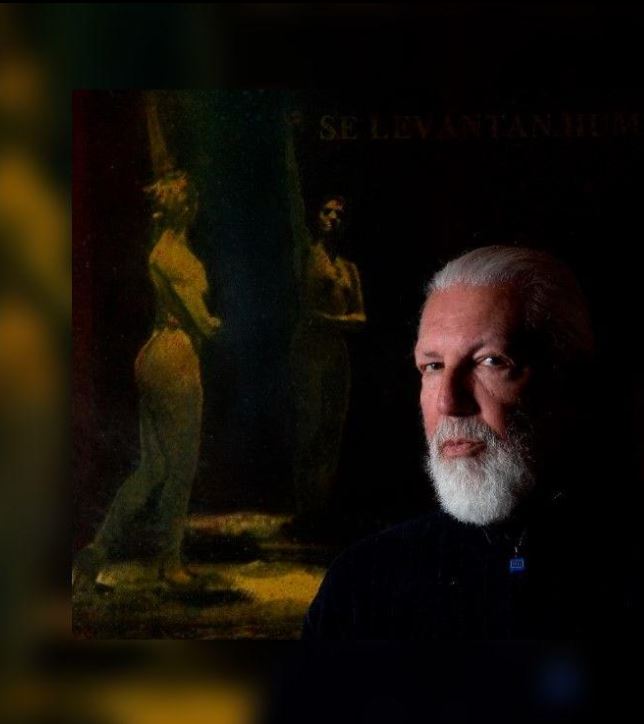
Rafael Hastings was born in Lima in 1945 and died on March 29, 2020. Painter, writer, filmmaker, performer, and pioneer of video art in Peru, he resisted confinement within a single medium. One of his most ambitious public works was the Mural of Humanity, a vast mosaic that extends along the perimeter of the National University of Trujillo, known as the UNT.
A work made for public space
The mural runs for approximately one kilometre around the university campus. Its scale changes the usual encounter with painting: it cannot be absorbed in one glance but unfolds as the viewer walks. Human figures, animals, landscapes, archaeological references, and natural forces appear in sequences that connect the memory of northern Peru with a broader meditation on humanity.
Small mosaic pieces give the surface durability, chromatic vibration, and changing reflections under daylight. They also demand exact planning. Every section must work at close range while remaining part of a composition whose full rhythm can only be perceived from a distance.
Conception and collective labour
Hastings led the design from the early 1990s, and the completed work was inaugurated in 2008. Translating drawings into a monumental mosaic required years of coordination, material preparation, and participation by specialists, students, and art graduates. Carlos del Mar contributed to the artistic direction alongside the production team.
The result is therefore both an authored vision and a collective undertaking. The university does not serve merely as a physical support: it becomes the patron of an artwork offered continuously to the city.
Video: A modern Renaissance artist
This Spanish-language profile presents the exceptional breadth of Hastings’s practice. Its images help explain why the Trujillo mural was not an isolated commission but part of a lifelong exchange among painting, movement, poetry, film, and experimentation.
An artist between disciplines
Born Abelardo Rafael Indacochea, Hastings studied painting and art history in Europe, including at the Royal Academy of Fine Arts in Brussels and the Royal College of Art in London. From the 1960s onward, his international career participated in debates that transformed Latin American art.
His work moved between figuration and abstraction and from canvas to moving image. Painting, experimental cinema, video, performance, dance, and writing were not separate careers but communicating territories. This freedom allowed him to investigate perception, anatomy, time, and everyday experience without submitting to one school.
Video: Hastings explains the mural
In this Spanish interview, the artist stands before the UNT mural and discusses its conception. His testimony reveals the practical and imaginative distance between proposing a monumental image and constructing it, piece by piece, as part of a city’s visible heritage.
Images, territory, and memory
The mosaic integrates references to the north coast, Chan Chan, architecture, vegetation, birds, bodies, and elemental forces. It does not offer a closed textbook chronology. Instead, history, myth, landscape, and contemporary life overlap in a visual narrative open to multiple routes.
It also transforms an urban boundary. A perimeter wall normally signals division; Hastings converted it into a surface of encounter. Passers-by receive an extended artistic experience without entering a gallery, purchasing a ticket, or even crossing the campus gate.
The legacy of Rafael Hastings
Hastings exhibited throughout the Americas, Europe, and Asia and received recognition for his experimental contribution. The National University of Trujillo awarded him an honorary doctorate in connection with his cultural work and the mural.
The Mural of Humanity remains among his most visible public legacies. Its importance exceeds its length: it demonstrates how a university can integrate art with architecture, preserve regional memory, support collective creation, and offer thousands of people a meaningful visual encounter every day.