Pedro Azabache: Painter and Teacher of Moche
Pedro Azabache made the people, labour, rituals, and landscapes of Moche central to a seven-decade career that joined painting, regional identity, and art education.
- Pedro Azabache
- Moche
- Peruvian Indigenism
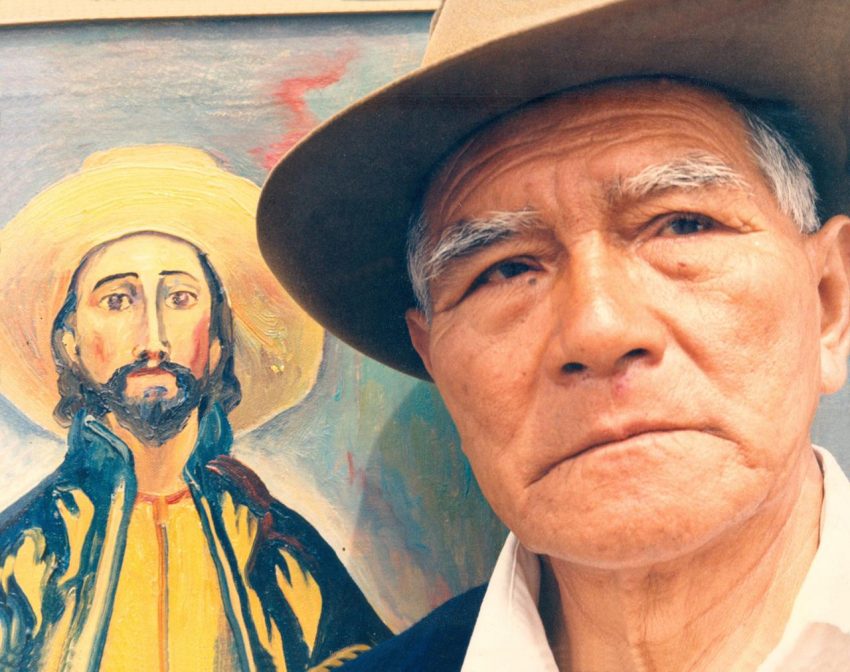
Pedro Azabache Bustamante was born on January 31, 1918, in the countryside of Moche, La Libertad, and died there on February 27, 2012. A painter, muralist, and teacher, he made everyday life in northern Peru the center of an art sustained by observation, memory, and profound identification with place.
Childhood and artistic formation
Azabache grew up among cultivated fields, religious celebrations, agricultural labour, and community customs. This world was not picturesque material viewed from outside; it was the reality he knew intimately. Its gestures, faces, rituals, and seasonal rhythms continued to nourish his work throughout his career.
In 1937 he entered the National School of Fine Arts in Lima. He studied with Julia Codesido and worked within the intellectual orbit of José Sabogal, central figures in the renewal of Peruvian Indigenism. Their teaching combined technical discipline, close attention to Peruvian cultures, and resistance to passive imitation of foreign models.
A painting rooted in Moche
His canvases portray farmers, festivals, popular saints, musicians, landscapes, and scenes of work. The marinera, Saint Isidore the Labourer, the portrait of his mother, and faces from the coast and highlands belong to an iconography refined over decades.
Vigorous drawing and warm color give his figures physical presence. Azabache did not reduce them to decoration. His costumbrista imagery has documentary force because landscape, work, history, and social life remain inseparable.
Video: An anthology of drawings
This primarily visual selection reveals a fundamental aspect of Azabache’s practice. Without the full resources of color, the drawings expose his assured line, attention to gesture, and ability to build character through economical means.
From Sabogal’s workshop to an independent voice
Azabache presented his first solo exhibition at Lima’s Ínsula cultural institute in 1944. The following year he collaborated with Sabogal on mural work for the Cusco Tourist Hotel, an experience that strengthened his command of large-scale painting and traditional techniques.
Although linked to Indigenism, he developed an unmistakable identity. He returned north when many artists sought to consolidate careers in Lima. That decision made regional experience a point of view: Moche was not an occasional subject but the place from which he interpreted Peru.
Video: Memory and endangered heritage
This Spanish report considers the painter’s memory and the condition of his material legacy. Beyond summarizing his career, it raises an urgent question: who is responsible for conserving the studios, archives, and works through which a region can reconstruct its artistic history?
Teacher and founder
In 1962 Azabache promoted an art studies center in Trujillo that eventually became the Macedonio de la Torre Higher School of Fine Arts. He served as its first director and taught for extended periods. His influence therefore reaches beyond the paintings bearing his signature and lives in generations of northern artists.
Creating sustained professional education outside the capital was itself a cultural achievement. Young people could develop rigorous artistic practices without abandoning the environment whose visual knowledge shaped them.
The legacy of Pedro Azabache
Azabache received local and national distinctions for his contribution to culture and education. His greatest achievement, however, was maintaining a coherent practice for more than seven decades and transforming the lived experience of Moche into a pictorial language of national significance.
His legacy joins image, identity, and teaching. He was a critical continuer of an important Peruvian movement, the maker of memorable figures, and the founder of a durable artistic community in the north.