A Virgin and Child Attributed to Murillo
The attribution of a Virgin and Child to Bartolomé Esteban Murillo opens a larger question: how do specialists decide who made an old painting?
- Bartolomé Esteban Murillo
- Virgin and Child
- art attribution
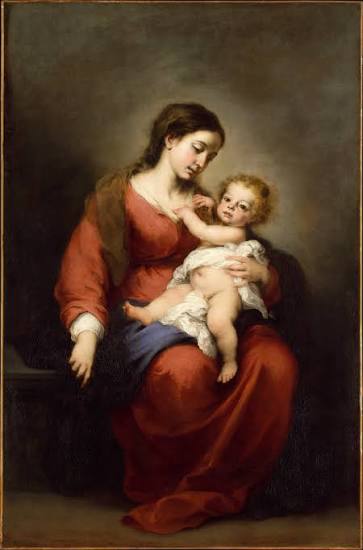
A painting of the Virgin and Child attributed to Bartolomé Esteban Murillo invites two kinds of looking. One attends to tenderness, light, gesture, and devotion; the other asks how confidently the work can be connected to the seventeenth-century Sevillian master. Responsible art history must keep both experiences in view.
Murillo and devotional painting
Murillo was baptized in Seville on January 1, 1618, and died there on April 3, 1682. He became celebrated for religious compositions whose soft light and accessible emotion brought sacred figures close to ordinary viewers. His Virgins often combine ideal beauty with an intimate exchange between mother and child.
Video: Virgin and Child in Glory
This English museum presentation examines a major Murillo painting through composition, color, movement, and devotional purpose. It establishes visual points of comparison without claiming that resemblance alone can prove authorship.
Attribution begins with provenance
Provenance reconstructs the chain of ownership, exhibition, sale, and publication. A continuous, well-documented history can strongly support an attribution; unexplained gaps invite caution. Old labels and inventories are evidence, but they must themselves be dated and authenticated.
Looking beneath the surface
Conservators study the support, ground, pigments, binding media, and craquelure. Infrared imaging may expose underdrawing, X-radiography can reveal compositional changes, and ultraviolet light helps distinguish original paint from later restoration. Results are compared with securely attributed works and materials available during Murillo’s lifetime.
Workshop, circle, or follower
Murillo directed a productive workshop, and successful designs were copied during and after his life. “Workshop of” may indicate direct studio participation; “circle of” suggests a contemporary associate; “follower of” points to later emulation. These labels acknowledge degrees of evidence rather than disguising uncertainty.
Video: Murillo’s self-portrait and artistic identity
In this English National Gallery video, close looking at Murillo’s self-portrait reveals how material details and historical context shape interpretation. The same disciplined attention underlies responsible attribution research.
Why uncertainty matters
Attribution affects scholarship, conservation, cultural prestige, and market value. For that reason, conclusions should emerge from collaboration among historians, conservators, scientists, and provenance researchers. A careful phrase such as “attributed to Murillo” is not a failure: it accurately describes the present state of knowledge while leaving room for new evidence.
The painting’s enduring significance
Authorship is important, but it is not the only source of meaning. The image also belongs to a long tradition of Marian devotion and Sevillian painting. Studied with intellectual honesty, it can illuminate both Murillo’s influence and the complex paths by which artworks survive, change hands, and acquire names.