Artist's Proofs: How to Read a Print Edition
Proof impressions reveal how printmakers test matrices, revise states, control editions, and balance repeatability with the material differences of each impression.
- artist's proof
- printmaking
- limited editions
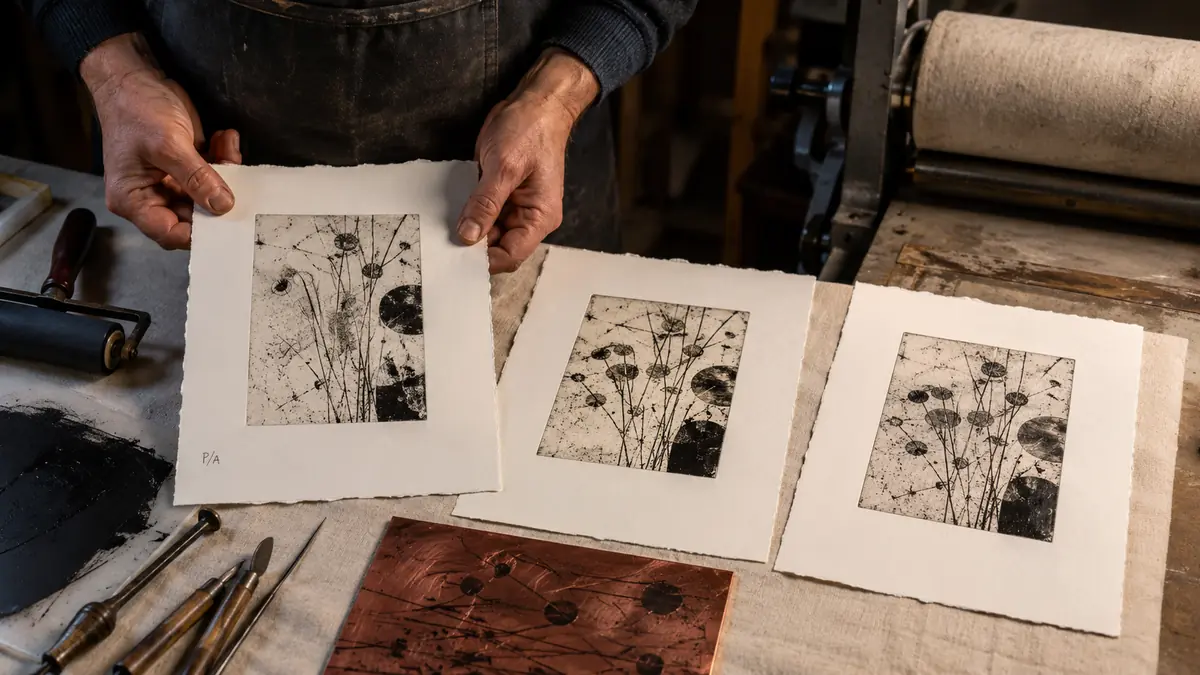
An artist’s proof is an impression reserved outside the regular numbered edition of a print. Commonly marked A/P in English or P/A in Spanish and French usage, it preserves the history of a process in which an artist tests, adjusts, approves, and sometimes varies the relationship between matrix, ink, paper, and pressure.
From matrix to impression
A print begins with a matrix: wood or linoleum for relief printing, metal for intaglio, stone or plate for lithography, and mesh for screenprinting. The matrix does not simply reproduce a pre-existing image. Reversal, resistance, pressure, and transfer actively shape the result.
What A/P means
Once the definitive state has been approved, a limited number of artist’s proofs may be printed alongside the edition. They are not automatically earlier, rarer in aesthetic quality, or more valuable than numbered impressions. Their importance depends on documentation, condition, authorship, and their relationship to the edition as a whole.
Video: Editions versus artist’s proofs
This English explanation shows how artists label and sign impressions. It clarifies the practical distinction between edition numbers and proofs while addressing the conventions a collector may find in the lower margin.
States and other proofs
A state records a deliberate change to the matrix. Trial proofs may show incomplete work; printer’s proofs recognize the specialist who printed the edition; bon à tirer proofs establish the approved standard. Terminology varies among workshops, so careful cataloguing matters more than assumptions based on initials alone.
How to read the margins
A fraction such as 7/30 means the seventh signed impression in an edition of thirty, not necessarily the seventh one physically pulled. A complete record may include title, date, technique, signature, chop mark, paper, printer, publisher, and notes about separate color variants.
Video: Printmaking at Artist Proof Studio
This English studio presentation connects edition practice to collaborative workshop culture. It demonstrates that printing requires judgment at every stage and that technical exchange can become a form of artistic education.
Pruebas de Artista in Lima
The exhibition Pruebas de Artista, presented during the third ICPNA International Print Biennial in March 2010, invited viewers to look beyond a finished image toward decisions embedded in its making. Such exhibitions are valuable because they restore process, uncertainty, and revision to an art form too often mistaken for mechanical duplication.
The significance of the proof
Every impression carries small material differences. Artist’s proofs make that variability visible and remind us that reproducibility does not erase touch. The most informed way to value a print is therefore to understand its technique, edition history, condition, and visual force together.