Cactus Veloz and Humana Naturaleza: Expanded Graphic Art
Paula Barragán and Verónica Noriega expand graphic art beyond the printed sheet, connecting body, territory, memory, and nature in two complementary projects.
- Paula Barragán
- Verónica Noriega
- Latin American printmaking
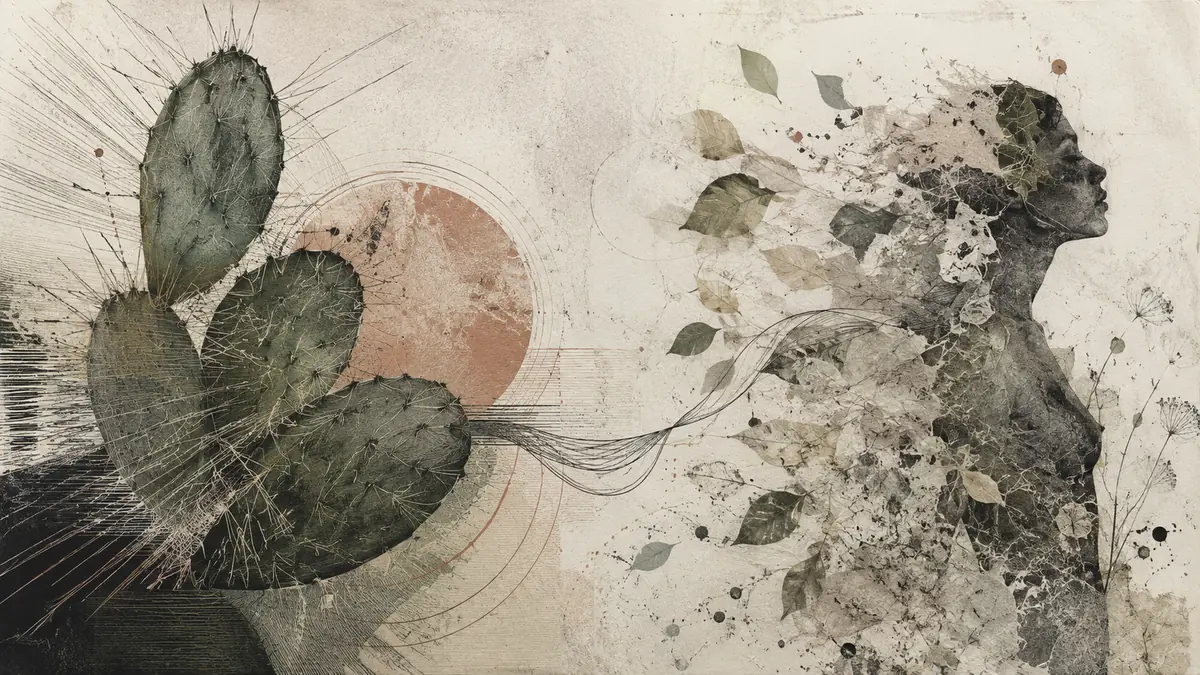
Cactus Veloz by Ecuadorian artist Paula Barragán and Humana Naturaleza by Peruvian artist Verónica Noriega formed a revealing dialogue at Lima’s Pancho Fierro Gallery during the third ICPNA International Print Biennial in 2010. Together, the projects asked how graphic art could leave the conventional sheet and occupy the viewer’s physical and imaginative space.
Two projects in dialogue
The pairing was not based on identical styles. Barragán and Noriega approached image-making from different sensibilities, yet both treated nature as an active system rather than a decorative background. Plants, bodies, marks, and territories appear as structures that grow, resist, migrate, and remember.
Paula Barragán and Cactus Veloz
Barragán’s title suggests a productive contradiction: the cactus is rooted and defensive, while velocity implies displacement. Her graphic language converts organic silhouettes into signs charged with rhythm. Repetition and variation allow the image to behave almost like a visual ecosystem.
Video: The origins of Paula Barragán’s practice
In this Spanish-language profile, Barragán discusses the experiences and visual interests that shaped her work. The presentation helps connect her formal decisions to a broader Latin American awareness of landscape and movement.
Verónica Noriega and Humana Naturaleza
Noriega’s project places the human figure inside nature rather than above it. The title joins two terms often separated by Western thought. Drawing and installation become ways to examine bodily vulnerability, instinct, transformation, and the porous boundary between interior life and the environment.
Beyond traditional printmaking
Modern graphic art includes more than ink transferred from a matrix. Artists may use seriality, impression, incision, layering, paper, objects, walls, or digital processes. What persists is a way of thinking through trace and reproduction. These exhibitions demonstrate how that logic can organize an entire space.
Video: Printmaking as a collaborative practice
This English-language presentation from Sasol visits Artist Proof Studio and offers context on printmaking and workshop collaboration. It provides a technical and educational companion to the discussion of expanded graphic art. It does not feature Verónica Noriega or document the 2010 exhibitions, and it should not be taken as evidence of the techniques used in their individual works.
The significance of the encounter
The exhibition’s lasting value lies in its cross-border conversation. Ecuador and Peru share ecological realities and cultural histories without producing interchangeable art. Barragán and Noriega show how local experience can generate distinct visual languages while participating in a wider debate about the body, nature, and the expanded field of printmaking.