Inside the PUCP Faculty of Art and Design
The PUCP Faculty of Art and Design grew from Adolfo Winternitz's humanist teaching project into a multidisciplinary center for artistic education in Peru.
- PUCP
- art education
- Peruvian art
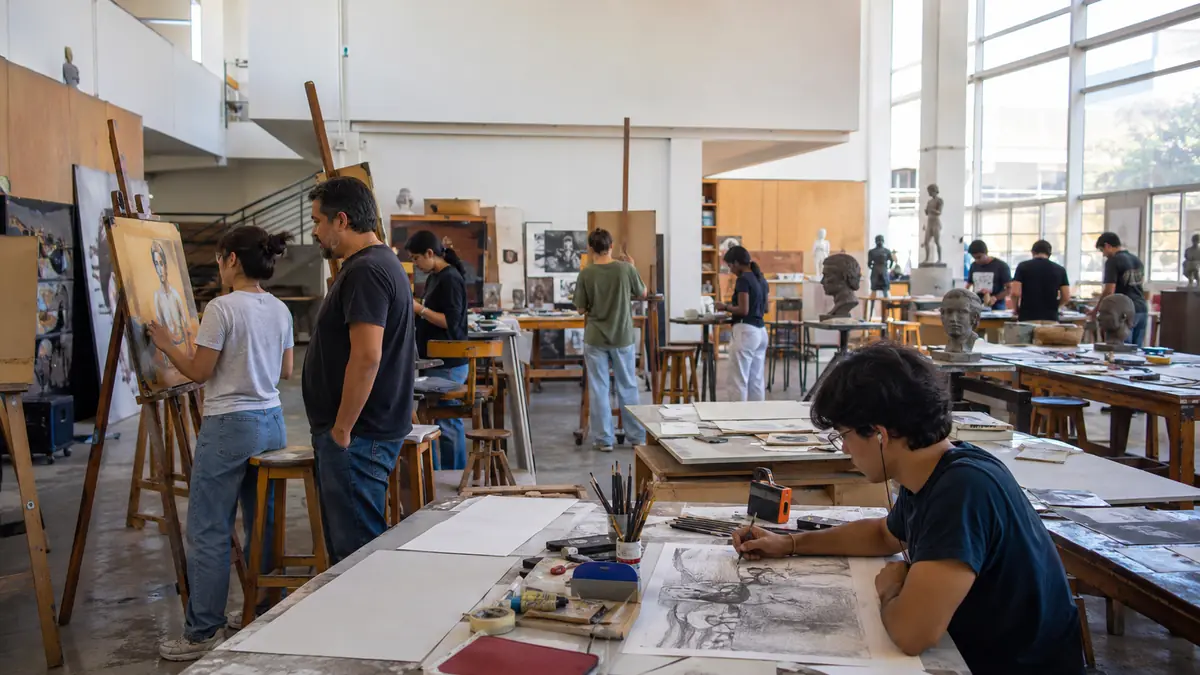
The Faculty of Art and Design at the Pontifical Catholic University of Peru is one of the country’s most influential centers for artistic education. Its history begins with a conviction that remains central to its identity: art is learned through sustained practice, critical reflection, and dialogue between inherited traditions and contemporary life.
Adolfo Winternitz and the founding vision
The Austrian-born artist Adolfo Winternitz arrived in Peru after leaving Europe during a period of persecution and war. In 1939 he began the educational initiative that opened as an art academy in 1940. Rather than treating technique as an isolated skill, his model joined studio discipline, humanist education, observation, and ethical responsibility.
From academy to university faculty
The institution became the PUCP School of Visual Arts in 1953, moved to the university’s San Miguel campus in 1969, and obtained faculty status in 1984. Since 2015 its name has reflected the expanded relationship between fine art, design, research, and new forms of visual communication.
Video: Student work and studio formation
This Spanish-language presentation enters the workshops through the projects of students. It shows how drawing, material experimentation, critique, and exhibition form a continuous learning process.
Learning through the workshop
The workshop is not merely a room equipped with tools. It is a method: students test ideas, receive criticism, revise decisions, and discover how materials can think alongside them. Painting, sculpture, printmaking, photography, digital media, conservation, and design develop distinct vocabularies while sharing this culture of inquiry.
Art, design, and society
Contemporary artistic education must address more than individual expression. Peruvian students work amid debates about cultural diversity, public memory, urban growth, ecology, technology, and inequality. The faculty therefore connects making with historical research and attention to the communities in which images circulate.
Video: Cross-disciplinary electives
This institutional video explains the role of elective study in widening a student’s practice. Its examples reveal why contemporary education benefits from movement across specialties rather than confinement within a single medium.
An enduring educational legacy
The faculty’s significance lies not in preserving one fixed style but in sustaining a demanding space for experimentation. Generations of artists, designers, teachers, and cultural workers have passed through its studios. Winternitz’s original humanist impulse survives whenever technical rigor becomes a means to observe the world more carefully and act within it responsibly.