Raphael: The Harmony of the High Renaissance
Raphael achieved a remarkable synthesis of clarity, movement, human feeling, and balance in painting and architecture during a life of only 37 years.
- Raphael
- High Renaissance
- School of Athens
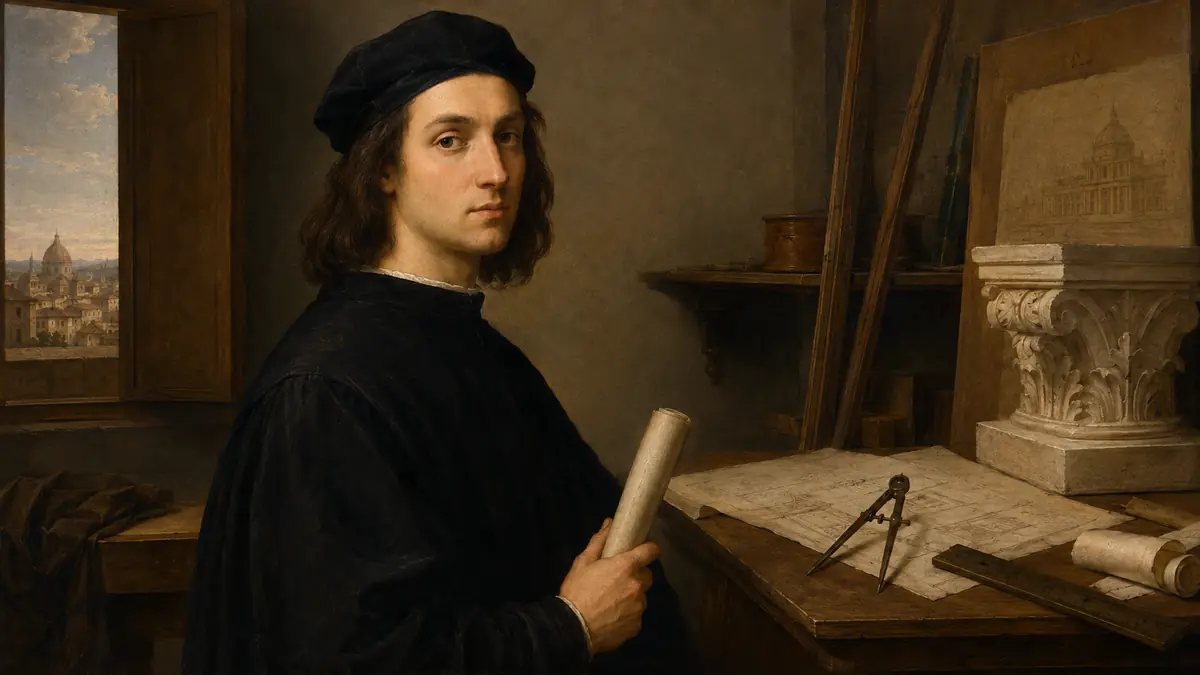
Raffaello Sanzio, known as Raphael, was born in Urbino on April 6, 1483, and died in Rome on April 6, 1520. In only 37 years, the painter and architect achieved an extraordinary synthesis of clarity, beauty, movement, and emotional balance.
Urbino and early formation
His father, Giovanni Santi, painted at the Urbino court. Orphaned young, Raphael nevertheless grew within a humanist environment where art and poetry shaped courtly life. His early formation is traditionally associated with Perugino, whose ordered spaces and measured figures he soon made more flexible.
Florence and synthesis
In Florence, Raphael studied Leonardo’s compositional groupings and atmospheric softness alongside Michelangelo’s powerful anatomy. He imitated neither. His Madonnas use gaze, gesture, and pyramidal structure to unite intimacy with monumentality.
Video: An introduction from the National Gallery
This English museum presentation follows Raphael’s formation, working method, and importance through close examination of paintings.
Rome and the Vatican Rooms
Pope Julius II summoned Raphael to Rome in 1508. The Vatican frescoes connect theology, philosophy, poetry, and law. The School of Athens gathers ancient thinkers within ideal architecture and turns humanist learning into a coherent public image.
Video: Reading The School of Athens
This English Smarthistory discussion explains perspective, groups, gestures, and intellectual context, showing how abstract ideas become a living scene.
Workshop, architecture, and major works
Raphael directed a large workshop producing frescoes, altarpieces, portraits, tapestry designs, and architecture. After Bramante’s death he assumed responsibility for Saint Peter’s Basilica. Major works include The Marriage of the Virgin, Sistine Madonna, Galatea, Transfiguration, and the portraits of Baldassare Castiglione and Julius II.
The legacy of Raphael
Raphael made harmony a form of visual intelligence. European academies treated his drawing and composition as models for centuries. Buried in Rome’s Pantheon, he left a legacy whose apparent ease conceals rigorous preparation and still defines the popular image of the High Renaissance.