Holography in Art: Light, Space, and Illusion
Holography records and reconstructs light itself, giving artists a medium where depth, movement, presence, and disappearance become material.
- holography
- art and technology
- light art
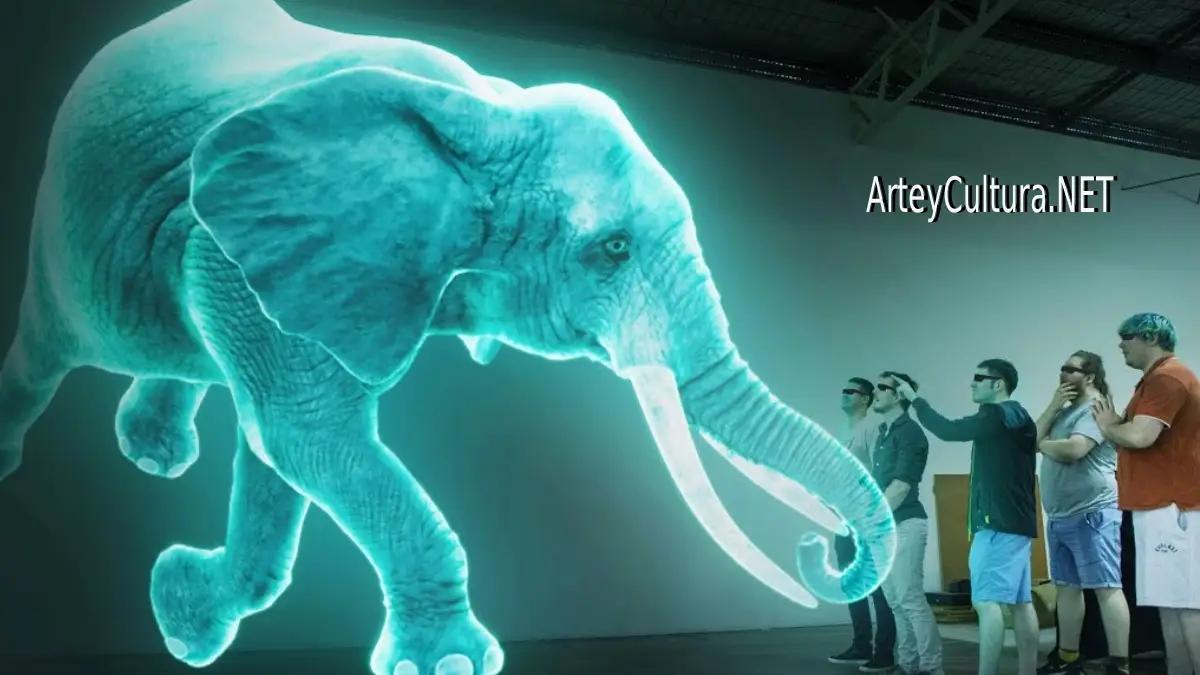
Holography records and reconstructs the light field coming from an object. Unlike ordinary photography, it preserves phase information, allowing an image to appear deep and to change perspective as the viewer moves.
Dennis Gabor and the original idea
Hungarian-British physicist Dennis Gabor was born in 1900 and died in 1979. He formulated holography’s principle in 1947 while seeking better electron-microscope resolution. The laser, developed in 1960, later supplied the coherent and stable light needed for high-quality results. Gabor received the 1971 Nobel Prize in Physics.
Recording a hologram
A laser beam is divided. One part reaches a photosensitive surface as a reference; another reflects from the object before arriving there. Their meeting produces a microscopic interference pattern. Correct illumination later diffracts light from that pattern and reconstructs multiple perspectives.
Video: What a hologram actually is
This English explanation from Edmund Optics distinguishes the underlying optical record from a conventional three-dimensional picture.
Not every floating image is holography
Transparent screens, angled reflections, spinning LED fans, and variants of Pepper’s Ghost are often marketed as “holograms.” They may be effective illusions, but they do not record a wavefront. Precision helps viewers appreciate each method on its own terms.
Video: The process in accessible form
This second English presentation summarizes interference, recording, and reconstruction through clear diagrams and examples.
An artistic material without substance
Artists use holography to explore presence, absence, movement, and memory. An image seems to occupy space but can vanish when light or viewing angle changes. The spectator’s movement therefore helps produce the work.
The significance of holographic art
Holography changed the relation between image and space by making structured light the medium itself. Its strongest future will not depend on novelty alone, but on works where technical method and artistic question genuinely need one another.