Piet Mondrian: Balance, Abstraction and a New Visual Reality
Piet Mondrian moved from Dutch landscape to dynamic abstraction, using unequal grids, primary colour and open intervals to imagine universal visual harmony.
- Piet Mondrian
- De Stijl
- abstract art
- Neo-Plasticism
- Dutch modernism
- Broadway Boogie Woogie
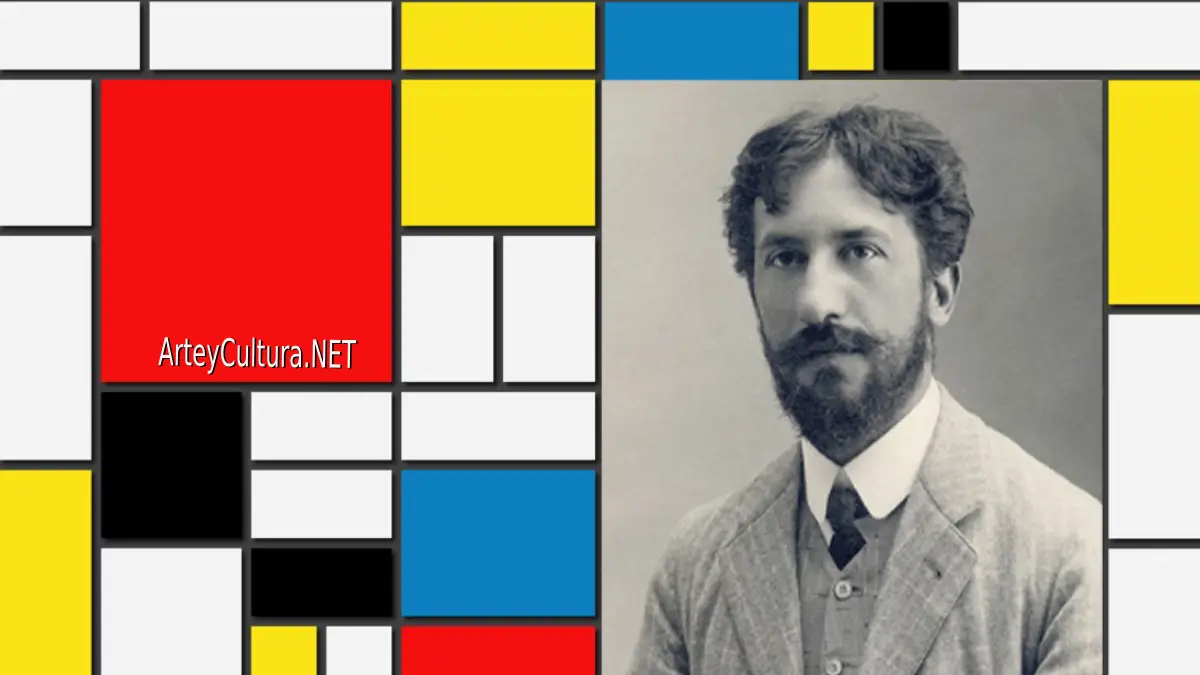
Pieter Cornelis Mondriaan, internationally known as Piet Mondrian, was born in Amersfoort, the Netherlands, on March 7, 1872, and died in New York City on February 1, 1944. His mature abstractions transformed a restricted vocabulary into remarkably varied fields of tension and rhythm.
From Dutch landscape to abstraction
Mondrian trained in Amsterdam and began with naturalistic landscapes, still lifes and rural motifs. Windmills, rivers and trees gradually became sites of structural experiment as colour intensified and contours grew more independent.
Encountering Cubism in Paris helped him dismantle conventional depth. Paintings of trees show this change step by step: branches become networks, volumes flatten and the observed motif approaches an autonomous arrangement.
De Stijl and Neo-Plasticism
With artists and designers associated with De Stijl, including Theo van Doesburg, Mondrian sought an art based on fundamental relationships. He called his approach Neo-Plasticism.
Verticals and horizontals, primary colours, white, grey and black did not form a decorative recipe. Their unequal intervals had to produce dynamic equilibrium without symmetry or a dominant central image.
Deconstructing an iconic design
This English Wall Street Journal film examines how Mondrian’s visual language works and why its apparent simplicity is difficult to reproduce. It separates the paintings’ carefully adjusted balance from later commercial imitations.
Paris, London and New York
War repeatedly changed Mondrian’s circumstances. He worked in Paris, moved to London in 1938 and reached New York in 1940. The city’s architecture, traffic and jazz encouraged new experiments with coloured lines and denser rhythms.
In Broadway Boogie Woogie, small blocks of colour pulse across the grid. The work retains geometric discipline but replaces heavy black divisions with a bright, syncopated circulation.
Meanings within abstraction
This English-language Yale University Art Gallery presentation considers the ideas behind Mondrian’s abstraction. It helps restore philosophical, spiritual and historical purpose to images too often treated merely as modern design motifs.
How to look at a Mondrian
Begin with difference rather than uniformity. Lines vary in thickness and termination; rectangles carry unequal visual weight; white areas operate actively rather than as empty background. The eye moves because no element settles the whole composition permanently.
Surface and revision matter as well. Close attention reveals paint handling and adjustments that reproductions often erase. These are made objects, not diagrams generated instantly from a rule.
The legacy of Piet Mondrian
Mondrian influenced painting, architecture, graphic design, fashion and popular culture. Widespread appropriation made his style instantly recognizable but sometimes detached it from its intellectual ambition. His lasting achievement is more demanding: he showed that a few relationships of line, colour and interval could sustain endless variation and embody a search for order within modern change.