Claude Monet: Light, Perception and Time in Painting
The outdoor practice, Impressionist exhibitions, serial paintings, Giverny garden and legacy of Claude Monet, whose work made changing perception a modern subject.
- Claude Monet
- Impressionism
- Water Lilies
- Giverny
- French painting
- plein air
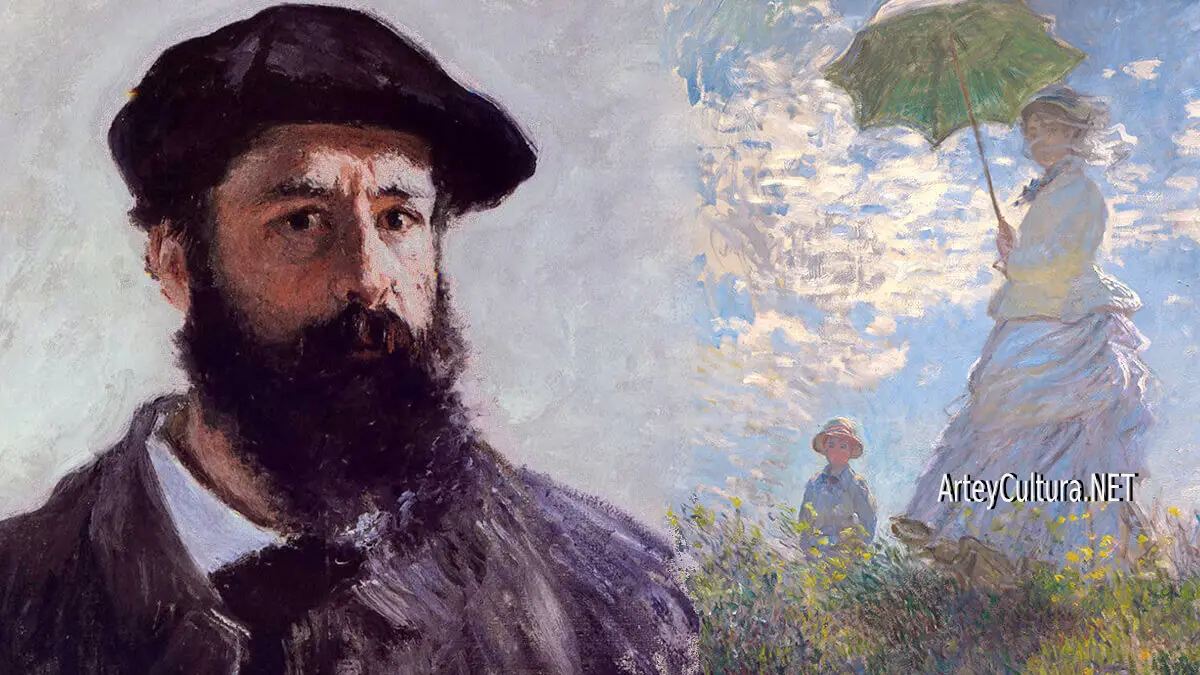
Oscar-Claude Monet was born in Paris on November 14, 1840, and died in Giverny on December 5, 1926. A founder of Impressionism, he made light, weather and the duration of looking central subjects of modern painting.
Le Havre and outdoor painting
Monet grew up in Le Havre, first gaining attention for caricatures. Eugene Boudin encouraged him to paint outdoors, where changing conditions demanded rapid decisions.
In Paris he formed relationships with Renoir, Bazille, Sisley and Pissarro. Their experiments challenged the hierarchy and finish preferred by official exhibitions.
The name Impressionism
Impression, Sunrise appeared in the independent exhibition of 1874. A critic used its title mockingly, and the label “Impressionists” became attached to the group.
Monet’s visible strokes do not indicate incomplete observation. They preserve differences between reflections, vapour, sky and water without pretending that perception is motionless.
Paintings in changing light
This language-neutral survey set to Beethoven allows landscapes and colour relationships to be compared without narration. The sequence makes weather and season visible as compositional forces.
Series and repeated motifs
Haystacks, poplars and the facade of Rouen Cathedral appear in many versions. Repetition converts one object into an experiment: the motif remains while hour, atmosphere and the painter’s response change.
The paintings were not always completed entirely before the subject. Studio revision and comparison helped Monet organise the series as related works.
Giverny and the Water Lilies
Monet shaped a garden and water pond at Giverny, effectively constructing the landscape he would study for decades. Japanese prints influenced the bridge and visual framing, while the pond became an almost horizonless field.
This English documentary examines the great Water Lilies decorations. Their panoramic scale surrounds peripheral vision and makes looking a bodily experience.
Legacy
Monet transformed the subject from a stable object into the experience of seeing it. His late paintings influenced abstraction because reflection, depth and surface can no longer be separated with certainty.