



The Pyramids of Giza: Architecture, Royal Power and Eternity
The Old Kingdom context, labour, construction evidence, funerary complexes and enduring legacy of the pyramids built for Khufu, Khafre and Menkaure at Giza.
- Giza pyramids
- ancient Egypt
- Khufu
- Egyptian architecture
- archaeology
- Old Kingdom
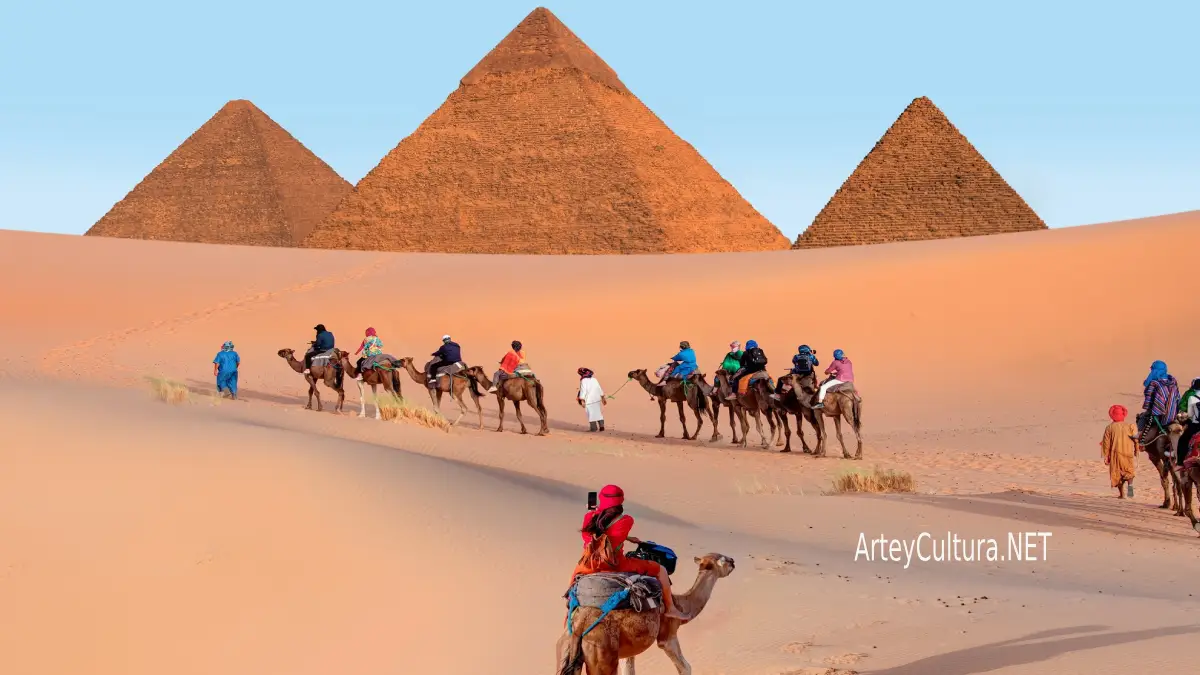
The great pyramids of Giza were built during Egypt’s Fourth Dynasty, roughly between 2600 and 2500 BCE. They formed royal funerary landscapes where architecture, ritual, administration and political authority were designed to endure together.
Three rulers and three complexes
The largest pyramid belonged to Khufu, known in Greek as Cheops. The other principal monuments were constructed for Khafre and Menkaure.
Each pyramid formed part of a larger complex with temples, causeways, subsidiary pyramids, cemeteries and spaces for continuing cult activity. Studying only the geometric mass hides much of its social function.
Labour and organisation
Archaeology has revealed worker settlements, bakeries, animal bones and burials near the site. The evidence supports rotating and specialised labour forces maintained by a centralised state rather than the old popular image of vast numbers of chained slaves.
This does not make labour easy or egalitarian. It replaces cinematic myth with a more complex history of taxation, skill, provisioning and hierarchy.
Seeing scale and interior space
This English TED-Ed reconstruction introduces the scale, labour and engineering choices behind Khufu’s pyramid. Its animated model makes hypotheses visible without turning them into a claim of complete certainty.
How could the stones move?
Quarries, sledges, prepared tracks, ropes, levers and different forms of ramp probably contributed. Surviving images and experimental archaeology show that wetting sand can reduce resistance when a loaded sledge moves across it.
No one ramp theory explains every stage with certainty. Changing height, block size and available working space may have required several methods.
The Great Pyramid
Khufu’s pyramid originally reached about 146.6 metres. Its passages, chambers and relieving spaces reveal precise planning, though modern names such as “King’s Chamber” do not prove exactly how every space functioned.
This English reconstruction compares construction hypotheses. Its value lies in making logistical sequences visible while preserving the distinction between plausible model and documented fact.
Transcendence and legacy
Giza is a UNESCO World Heritage site and the Great Pyramid is the only surviving Wonder of the Ancient World. Its transcendence rests not in imaginary lost technology, but in accumulated knowledge, organised labour and an architectural vision of royal permanence.