Alexander Calder: Movement, Balance and Sculpture in the Air
The engineering background, wire figures, mobiles, stabiles and legacy of Alexander Calder, who made real movement and changing balance central to modern sculpture.
- Alexander Calder
- kinetic sculpture
- mobiles
- stabiles
- modern sculpture
- public art
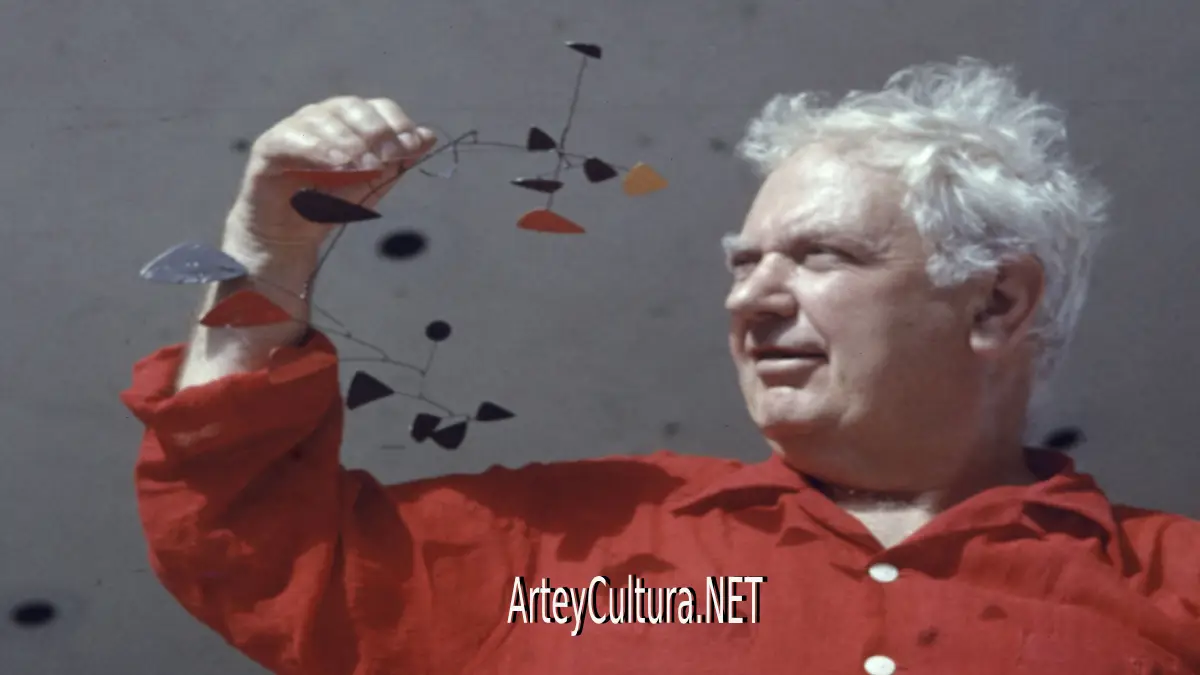
Alexander Calder was born in Lawnton, Pennsylvania, on July 22, 1898, and died in New York on November 11, 1976. He changed modern sculpture by making actual movement, shifting balance and surrounding air part of the work.
Engineering before art school
Calder came from a family of artists but first trained as a mechanical engineer. Knowledge of forces, materials and moving systems later supported an art that appears playful while depending on precise physical relationships.
After studying at the Art Students League in New York, he worked as an illustrator and began making animals and figures from wire. Line escaped the page and occupied real space.
Cirque Calder
In Paris, Calder developed a miniature circus of wire, cloth, cork and found material. He performed it manually for audiences of artists and friends, animating acrobats, animals and machinery.
The circus joined sculpture, performance and engineering. Its humour should not hide the serious investigation of how minimal forms can communicate weight, personality and action.
Calder in motion
This language-neutral visual survey reveals what still photographs cannot: a mobile never presents the same arrangement for long. Small currents of air alter distances, overlaps and shadows.
From Mondrian’s studio to abstraction
A 1930 visit to Piet Mondrian’s studio was decisive. Calder imagined coloured rectangles moving in space and soon developed abstract constructions, first mechanically driven and later moved freely by air.
Marcel Duchamp used the term mobile for these works; Jean Arp proposed stabile for Calder’s stationary abstract structures. The two terms describe complementary investigations rather than opposing phases.
Balance as an artistic material
A mobile is not random decoration. Each element has weight and leverage, and the whole must remain responsive without collapsing. Motion continuously redraws the composition through time.
Monumental stabiles transfer bold planes and curves into public space. Works such as Flamingo and La Grande Vitesse create passages around and through sculpture, changing how pedestrians perceive an urban site.
One mobile examined
This English presentation of an untitled mobile focuses attention on suspension, shadow and slow variation. The work is completed not by one ideal viewpoint but by a sequence of encounters.
Achievements and legacy
Calder made time and equilibrium central sculptural materials, influenced kinetic art and created a model for ambitious modern public sculpture. His legacy reminds us that stability can be dynamic: balance is an event continually achieved.