Tintoretto: Speed, Light and Drama in Venice
The life, workshop methods, major paintings and legacy of Tintoretto, whose diagonal spaces and urgent light transformed Venetian Renaissance art.
- Tintoretto
- Jacopo Robusti
- Venetian painting
- Renaissance art
- Scuola Grande di San Rocco
- Mannerism
Jacopo Robusti, known as Tintoretto, was born in Venice around 1518 and died there on May 31, 1594. He transformed Venetian painting through steep perspectives, urgent movement and shafts of light that turn sacred history into immediate theatre.
A name from the family trade
His father was a dyer, or tintore, and the nickname Tintoretto means “little dyer.” Reliable evidence about his formal training is limited, although later tradition connected him briefly with Titian’s workshop.
Tintoretto studied Venetian colour and central Italian drawing. A famous description of his ambition—to unite Michelangelo’s drawing with Titian’s colour—captures the synthesis, even if the exact wording belongs partly to legend.
Speed, models and workshop practice
He became known for rapid execution and fierce pursuit of commissions. Small wax or clay figures arranged in model spaces may have helped him test extreme viewpoints and artificial lighting before painting.
Speed did not mean absence of planning. Large canvases required compositional invention, material preparation and a workshop capable of assisting without erasing the master’s directing intelligence.
The Scuola Grande di San Rocco
This Spanish-language tour examines Tintoretto’s vast programme for the Scuola Grande di San Rocco. The building preserves an exceptional concentration of his work, allowing visitors to experience paintings as a connected environment rather than isolated museum objects.
Space activated by light
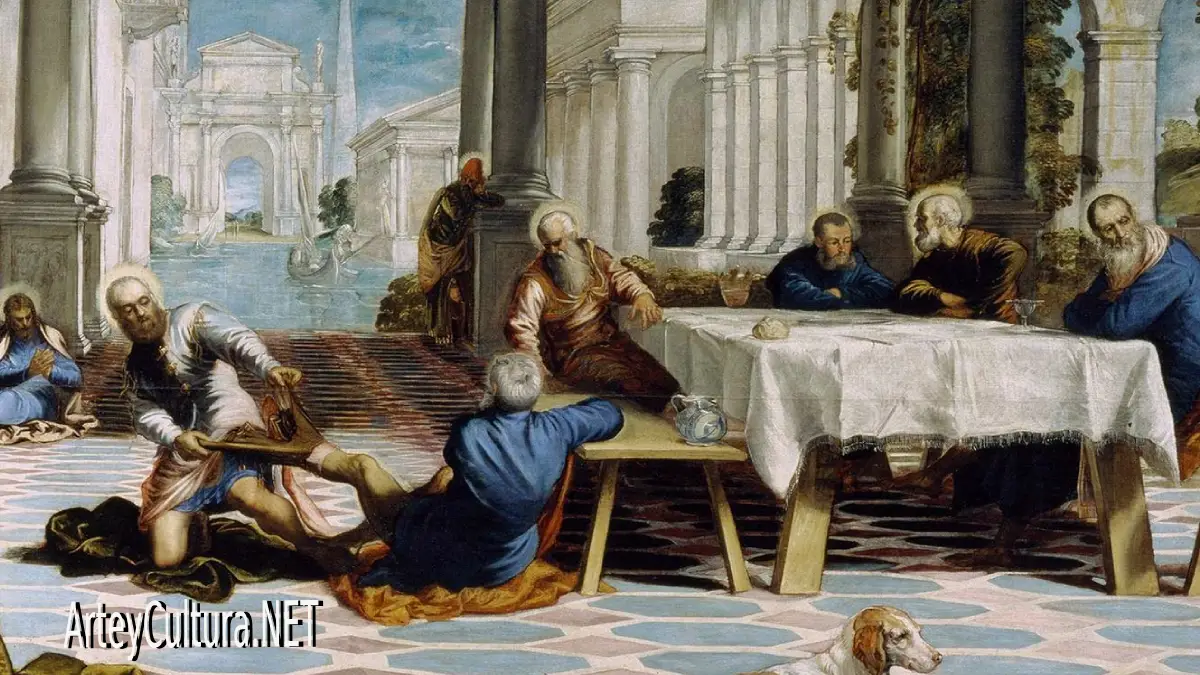
In works such as The Miracle of the Slave and The Last Supper, action often moves diagonally into depth. Figures enter from unexpected edges, architecture channels vision and illumination selects the spiritual centre.
The viewer is not offered the balanced stability of the High Renaissance. Space feels contingent and theatrical, as if an event were unfolding beyond the frame and continuing into the room.
Major works and Venetian ambition
The Washing of the Feet uses a long interior and displaced focal points to make the eye travel. Tintoretto’s enormous Paradise in the Doge’s Palace marshals a celestial multitude across one of the largest canvases of its era.
Portraits show another register: dark backgrounds and restrained gesture concentrate attention on the sitter’s face. This quieter work complicates the familiar image of Tintoretto as a painter only of speed and spectacle.
A final masterpiece reconsidered
This English-language video discusses the visual strategies of Tintoretto’s late work. Its close views help explain how loose brushwork, darkness and directional light create coherence across crowded scenes.
Achievements and legacy
- He made perspective and illumination active forces of dramatic narration.
- His San Rocco cycle created one of the great immersive painted environments in Europe.
- He expanded the scale and emotional urgency of Venetian religious painting.
- His diagonals and theatrical light anticipated important features of Baroque art.
Tintoretto’s legacy is movement made architectural. Bodies, buildings, light and the spectator’s own gaze are pulled into the same unstable event.