
The Cat Concerto: Music and Comic Timing in Tom and Jerry
The production, musical structure, rivalry and legacy of The Cat Concerto, the 1947 Tom and Jerry short that turned a Liszt rhapsody into animated comedy.
- The Cat Concerto
- Tom and Jerry
- Franz Liszt
- animation history
- William Hanna
- Joseph Barbera
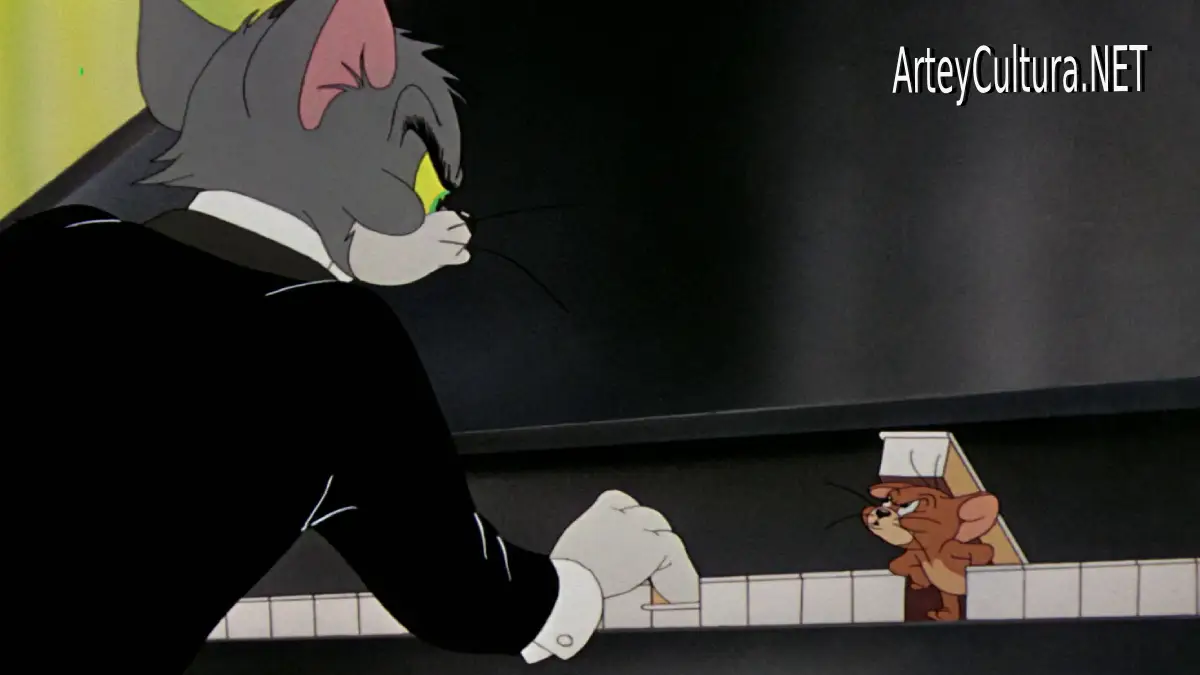
The Cat Concerto is a Tom and Jerry animated short released by Metro-Goldwyn-Mayer in 1947. Directed by William Hanna and Joseph Barbera, it turns Franz Liszt’s Hungarian Rhapsody No. 2 into both concert performance and precisely engineered comic conflict.
A formal recital invaded
Tom enters as an elegant concert pianist, bows to the audience and begins Liszt’s demanding work. Jerry is sleeping inside the piano and responds angrily when the music disturbs him.
The contrast is immediate: public refinement meets the familiar private rivalry between cat and mouse. The piano becomes instrument, hiding place, trap and entire theatrical stage.
Music as the structure of action
The score does not sit behind the images as accompaniment. Accents, scales, pauses and changes of tempo determine gestures and impacts. Jerry’s interventions alter Tom’s performance without breaking the musical continuity.
This integration required detailed timing before animation. Every pose had to correspond to a particular point in the recording, while the comedy still needed to feel spontaneous.
Watching the complete construction
This language-neutral presentation allows the full musical architecture to be followed. Notice how the film saves increasingly extreme action for the rhapsody’s faster passages, making escalation feel both narrative and musical.
Performance behind the cartoon
Animator and pianist skills meet in Tom’s hands. Although physical exaggeration frequently takes over, many keyboard actions correspond closely enough to the music to sustain the illusion of a real recital.
Scott Bradley, the musical director associated with the Tom and Jerry series, was central to the studio’s sophisticated coordination of orchestral scores and screen action. Classical repertory became material for visual invention rather than a badge of prestige.
A famous parallel with Bugs Bunny
The same year brought Warner Bros.’ Rhapsody Rabbit, in which Bugs Bunny also performs Liszt while battling a mouse. Similarities led to a long-running dispute over priority and possible access to ideas, but no final simple explanation has displaced both films from animation history.
The controversy is useful because it shows how studios worked simultaneously with common musical sources, familiar comic premises and intense commercial competition.
Concert madness revisited
This English WB Kids presentation highlights the enduring clarity of the premise. Modern viewers need little context: solemn concentration and escalating sabotage remain immediately legible.
Achievement and legacy
The Cat Concerto won the Academy Award for Best Animated Short Film. Its transcendence lies in exact audiovisual construction: music generates action, action appears to transform music, and neither element can be removed without collapsing the joke.