



The Guggenheim Museum in New York: Art and Architecture in a Spiral
The history, collection and debated architecture of the Solomon R. Guggenheim Museum designed by Frank Lloyd Wright on Fifth Avenue.
- Solomon R. Guggenheim Museum
- Frank Lloyd Wright
- New York architecture
- modern art museum
- Hilla Rebay
- museum design
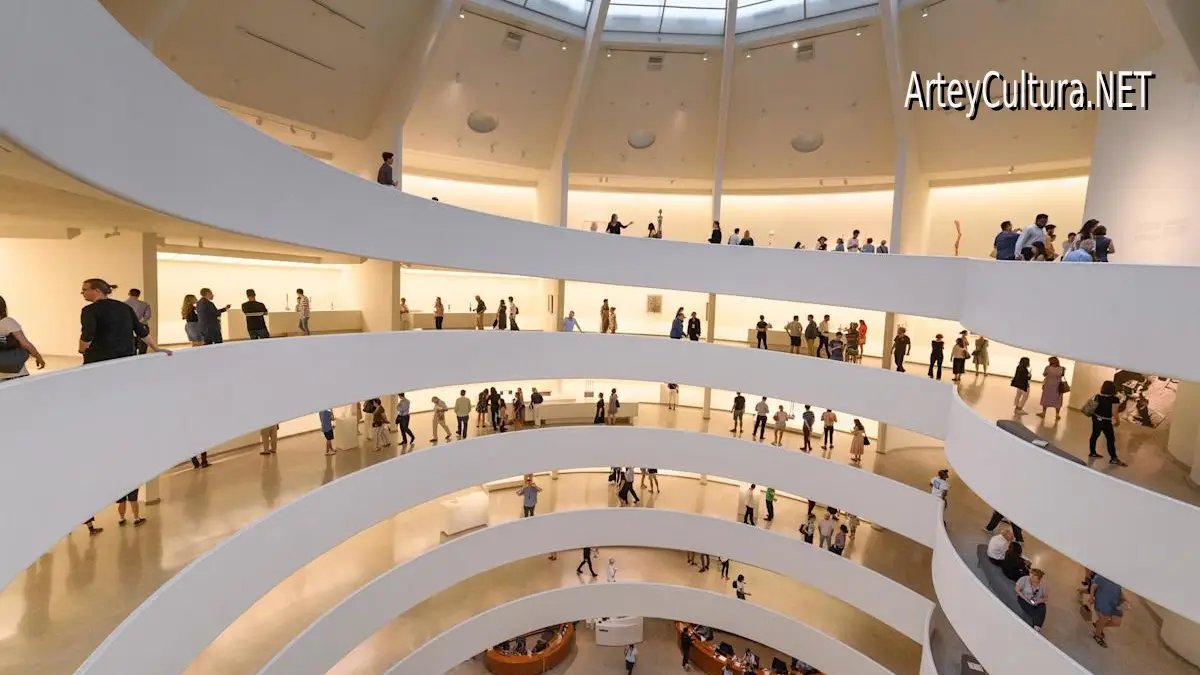
The permanent building of the Solomon R. Guggenheim Museum opened in New York on October 21, 1959. Designed by Frank Lloyd Wright, its ascending spiral transformed the museum from a sequence of neutral rooms into a continuous architectural experience.
Solomon Guggenheim and Hilla Rebay
Industrialist Solomon R. Guggenheim began collecting non-objective art under the guidance of artist and curator Hilla von Rebay. In 1937 he established a foundation, and two years later the Museum of Non-Objective Painting opened in a temporary Manhattan space.
Rebay believed abstraction could carry spiritual meaning. Her vision helped form holdings in artists such as Vasily Kandinsky, Rudolf Bauer and Paul Klee, although later institutional narratives sometimes minimised her central role.
Frank Lloyd Wright’s commission
Wright received the museum commission in 1943. The project required sixteen years of design changes, negotiations, rising costs and construction. Neither Wright nor Solomon Guggenheim lived to see the completed building.
A broad ramp coils around a central rotunda beneath a skylight. Visitors can rise by lift and descend gradually, encountering art along an almost continuous path rather than moving from gallery to gallery.
An architectural tour
This English tour from the Guggenheim Museum explains the ramp, rotunda and later alterations. Movement through the building reveals relationships among visitors, artworks and levels that a photograph of the exterior cannot convey.
A beautiful but difficult museum
Artists and critics objected even before opening that curved walls, inclined floors and powerful architecture could compete with the art. Paintings cannot always hang conventionally, and large installations must negotiate a space that refuses to disappear.
That difficulty is part of the building’s significance. Every exhibition becomes an interpretation of Wright’s form rather than an arrangement inside an invisible container.
Wright’s design in context
This English Smarthistory discussion places the museum within Wright’s architecture and the urban grid of Fifth Avenue. Its organic spiral is radical precisely because it confronts the rectangular apartment blocks and museum conventions surrounding it.
Collection, expansion and preservation
The collection grew to include major works by Kandinsky, Picasso, Chagall and many modern and contemporary artists. A rectilinear tower designed by Gwathmey Siegel expanded exhibition space in the 1990s, while restoration addressed cracks in the original concrete shell.
In 2019 the building joined seven other Wright works on the UNESCO World Heritage List. The recognition treats it not merely as museum property but as a major experiment in twentieth-century architecture.
Achievements and legacy
- The museum gave non-objective art a major early institutional platform in the United States.
- Wright turned circulation into the governing form of a museum.
- Its exhibition difficulties generated new curatorial responses.
- The building became an international symbol of New York and modern architecture.
The Guggenheim’s legacy lies in refusing neutrality. It asks every visitor and every artwork to enter a conversation with architecture that is beautiful, demanding and impossible to ignore.