

Som Sabadell: Beethoven Appears in a Public Square
The story and musical construction of the Som Sabadell flashmob, in which orchestra and choirs transformed a public square with Beethoven's Ninth Symphony.
- Som Sabadell
- Beethoven
- Ninth Symphony
- Ode to Joy
- flashmob
- orchestra
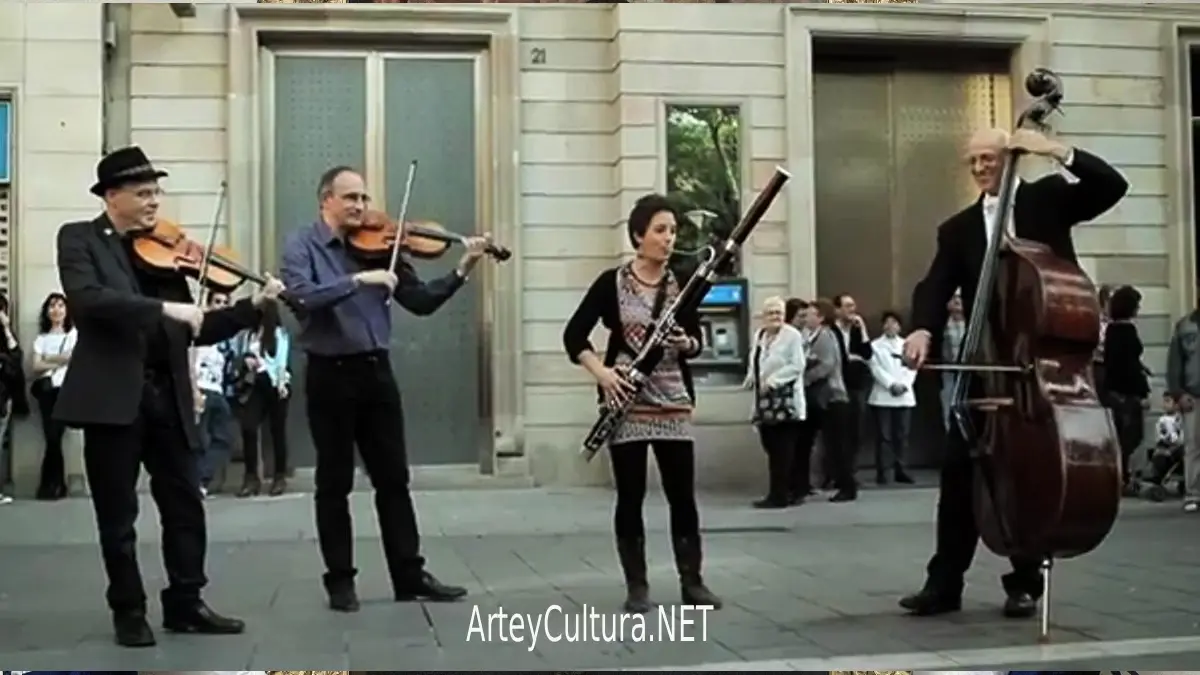
In 2012, a public square in Sabadell, near Barcelona, became the stage for the finale of Beethoven’s Ninth Symphony. The film known as Som Sabadell begins with one double bassist and gradually reveals an orchestra, choirs and a crowd discovering that an ordinary afternoon has become a collective musical event.
What happens in the square
A child places a coin near the first musician. Cellos, woodwinds, violins, brass and percussion join in stages; singers finally emerge from among the public. The accumulation is easy to understand even for viewers unfamiliar with orchestral music because they can see each new layer enter.
The surrounding audience becomes part of the image. Children conduct, adults raise phones and strangers exchange reactions. Their presence gives the performance its social meaning: the work is not merely relocated outdoors but discovered in public.
Surprise built through planning
Although the event appears spontaneous, it required rehearsals, permits, camera positions, sound recording and careful spatial coordination. The word flashmob describes the unexpected appearance from the audience’s perspective, not musical improvisation. Professional precision creates the conditions in which surprise feels effortless.
The original Som Sabadell film
Musicians from the Orquestra Simfònica del Vallès and several choirs participated in this anniversary campaign for Banco Sabadell. The language-neutral performance uses editing to alternate instruments, faces and reactions, allowing online viewers to discover the growing ensemble almost alongside the people in the square.
The sponsorship is part of the work’s context. A bank associates its identity with community, optimism and culture. Recognizing the advertising purpose does not cancel the musical emotion, but it enables a more complete reading of how that emotion is produced and circulated.
Beethoven’s Ninth Symphony
Ludwig van Beethoven was born in 1770 and died in 1827. His Ninth Symphony premiered in Vienna on May 7, 1824, when his hearing loss was profound. Introducing vocal soloists and chorus into the symphonic finale was an extraordinary decision that expanded expectations of what the genre could contain.
Schiller’s “Ode to Joy”
The text comes from Friedrich Schiller and imagines human fraternity. Beethoven’s principal melody is direct enough to recognize after a few notes, yet it supports an immense orchestral and choral architecture. That combination—accessibility and scale—makes it particularly effective in a public intervention.
Another orchestra, another community
This language-neutral performance by the Wayzata Symphony Orchestra and Edina Chorale offers a useful comparison. The same music unfolds within a different building, acoustic and community. Changes in camera placement and audience proximity show that a repeated format never produces an identical event.
Classical music beyond the concert hall
Taking an orchestra into daily life lowers symbolic barriers. People who did not buy a ticket or plan a cultural visit encounter a symphonic work directly. A viral performance cannot replace sustained access, music education or fair opportunities for musicians, but it can open a door and make the orchestra’s collective construction visible.
Achievements of the intervention
- It brought a major symphonic work into an ordinary public setting.
- It made the gradual construction of orchestral sound easy to see.
- It joined musicians, accidental spectators and digital audiences.
- It renewed popular attention to the finale of Beethoven’s Ninth.
Som Sabadell succeeds through a simple idea executed with care: where there was only traffic and routine, a musical community appears and turns strangers, for a few minutes, into a shared audience.