Children and Creativity: Art as a Way of Discovering
A practical guide to creativity in childhood, drawing, play and adult support so that art remains a field of exploration rather than a test of perfection.
- children and art
- creativity
- art education
- process art
- play-based learning
- emotional expression
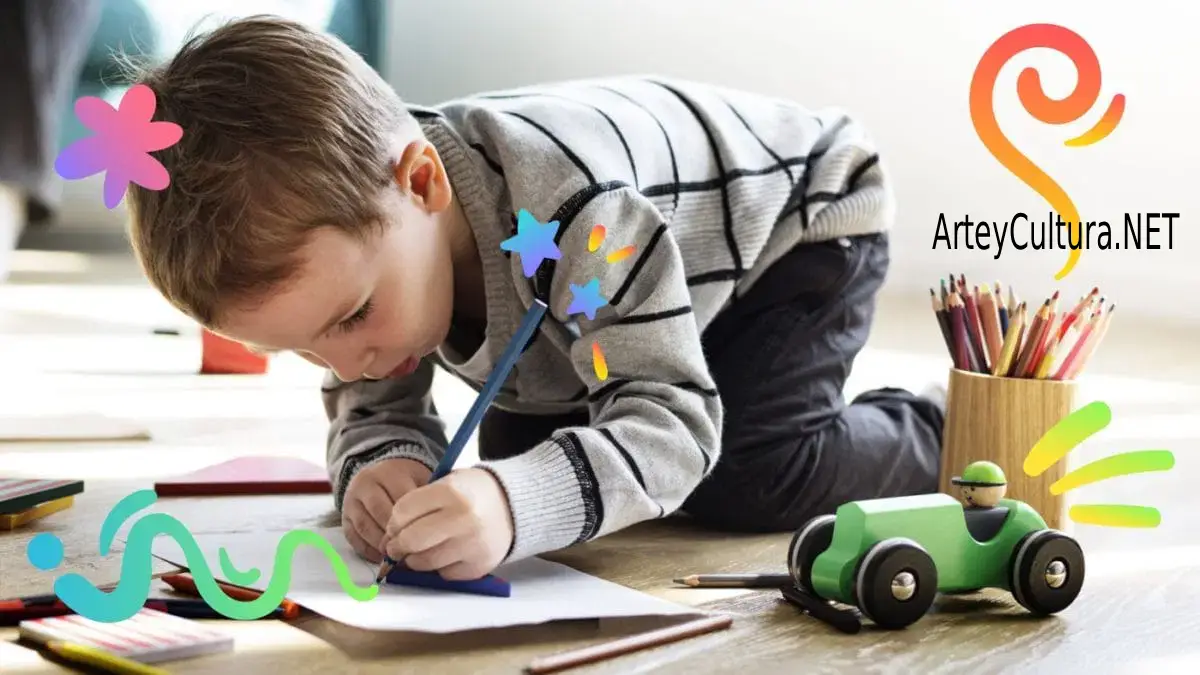
Childhood creativity is not a rare talent possessed by a gifted few. It is a way of exploring, combining experience and communicating what cannot yet be expressed easily in words. Drawing, painting, modelling, singing and dramatic play help children observe the world and test responses of their own.
The adult’s task is not to manufacture perfect results. It is to create safe conditions in which curiosity can survive uncertainty, mess and revision.
Creating is not perfect copying
When the main goal is to reproduce an adult model, children learn to fear mistakes. A creative activity can offer materials and an open prompt while preserving meaningful choices.
The result may be strange, incomplete or unexpected. That is often where learning occurs: the child has encountered a problem and invented a response rather than merely followed instructions.
Process and product
Product-centred activities define in advance what every finished object should look like. Process art focuses on exploration: mixing colour, testing texture, arranging forms and discovering how materials behave.
Products are not forbidden. Children can plan and complete ambitious work. The distinction is whether the adult’s model controls every decision or the child participates in forming the purpose and method.
Play-based art in practice
This English film from the Children’s Museum of New Hampshire compares process-based and product-based activity. Concrete examples show how an invitation can teach material skills without requiring every child to produce an identical object.
Simple materials, broad possibilities
Paper, cardboard, clay, fabric, pencils and safe recycled objects can support rich experiences. A limited but varied selection prevents overload. Materials should be suitable for age, and the workspace should permit both making a mess and participating in cleanup.
Rotation can renew attention without constant consumption. A familiar material placed beside one new tool often produces more sustained invention than an enormous unstructured pile.
Ask rather than guess
When looking at a drawing, “What is happening here?” opens conversation. Questions about colours, choices and stories respect the child’s intention. Immediately saying “What a beautiful dog” may close the exchange if the drawing was not a dog.
Open observation also gives children language for reflecting on process: what changed, what was difficult and what they might try next.
Why schools need creativity
In this concise English talk, Sir Ken Robinson argues that schools should not treat creativity as a minor addition to serious learning. His central point extends beyond the arts: children need permission to take intellectual risks without every unsuccessful attempt becoming a judgement on ability.
The adult’s role
Adults prepare conditions, demonstrate safe tool use and remain available without taking ownership. Completing a child’s work so that it “looks right” replaces agency with adult standards.
Specific recognition is more useful than automatic praise. “You kept trying different ways to join those pieces” directs attention to persistence and decision rather than ranking beauty.
Art and emotional development
An image can express fear, joy or conflict without demanding immediate explanation. Art does not replace professional psychological care when that is needed, but it offers a channel for identifying emotion, narrating experience and regaining a sense of control.
Adults should avoid diagnosing a child from one drawing. Meaning emerges through context, conversation and patterns over time.
Creating together
Murals, dramatic play and musical projects require negotiation. Children share space, listen and accept that collective work will differ from any one person’s original idea.
Educators can ensure that confident voices do not dominate. Roles can rotate, and quiet forms of participation can be valued alongside visible leadership.
Avoid comparison and competition
Ranking children’s work by realism or beauty introduces competition into a field that should permit difference. An exhibition can present each work with the maker’s name and a sentence about their idea, without declaring winners.
Comparison is useful when a child compares their own experiments and notices change. It becomes harmful when adult judgement defines one narrow standard for everyone.
Contributions of art in childhood
- It strengthens coordination, attention and observation.
- It expands ways to express emotions and ideas.
- It develops flexibility and problem-solving.
- It supports autonomy, persistence and confidence.
- It teaches collaboration and respect for different interpretations.
The best childhood art activity does not produce miniature adults or perfect copies. It creates a place to try, fail and discover that an original idea can take form.