Ron Mueck: Scale, Presence and the Human Body
The life, techniques and legacy of Ron Mueck, the Australian-born sculptor whose uncannily detailed figures alter scale to explore human vulnerability.
- Ron Mueck
- contemporary sculpture
- hyperrealism
- figurative art
- human body
- scale
A sculptor of human presence
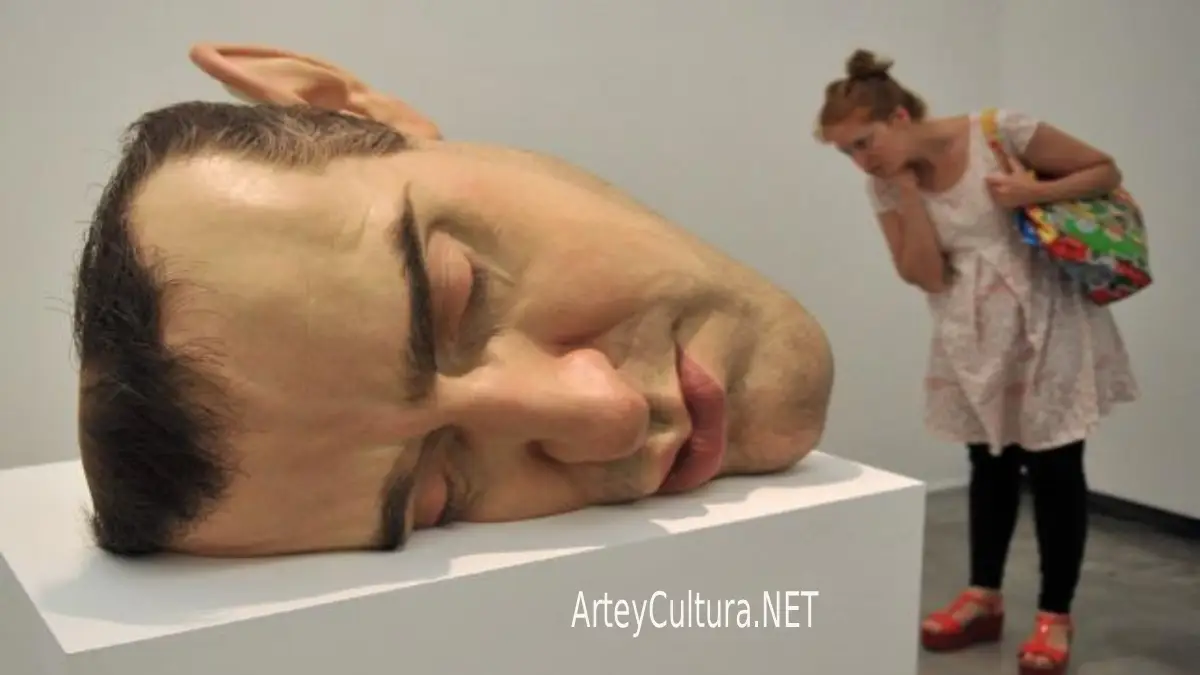
Ron Mueck, born in Melbourne, Australia, on 9 May 1958, is one of the most influential figurative sculptors in contemporary art. His figures reproduce skin, hair, anatomy and gesture with extraordinary precision, yet they never try simply to pass as living people. Their gigantic or miniature scale breaks the illusion and changes how viewers occupy the room.
A monumental head invites scrutiny of pores, stubble and an inward expression. A reduced body creates an intimacy that would be impossible in front of a life-size model. Scale turns close observation into a psychological encounter.
From puppetry to contemporary art
The son of toy makers, Mueck did not follow a conventional academic path. He created models, puppets and special effects for television, advertising and film, including work connected with Jim Henson’s creative world and the fantasy film Labyrinth.
In 1996, painter Paula Rego commissioned him to make a small figure of Pinocchio. Charles Saatchi then encountered his work and included it in the 1997 exhibition Sensation. Mueck’s contribution, Dead Dad, was a naked representation of his recently deceased father at roughly half life-size. Its physical directness and emotional restraint immediately commanded attention.
What does reality mean in sculpture?
In this English-language interview produced by the Fondation Cartier, curator Anthony d’Offay discusses Mueck’s practice and the distinctive experience of encountering the sculptures in person. The commentary helps separate detailed realism from mere imitation: their credibility is the starting point, not the final purpose.
Materials and painstaking construction
Mueck works with silicone, fibreglass, resin, pigments and fibres. A figure may begin as a clay model before moulds and casts establish its final structure. Translucent layers of colour suggest circulation, freckles and uneven skin tone; individual hairs may be inserted by hand.
The process is slow because visual accuracy depends on countless decisions. A wrinkle must respond to posture, an eyelid must carry weight and a patch of redness must appear bodily rather than painted. The handmade nature of the work explains why his total production remains comparatively small.
Scale as the decisive instrument
Mueck almost never works at ordinary human size. A life-size figure risks becoming a mannequin, something familiar enough to dismiss. Enlargement and reduction preserve anatomical recognition while preventing routine perception.
This strategy also changes power. Viewers may feel physically dwarfed by a seated woman or unexpectedly protective toward a tiny adult body. The sculpture determines distance, movement and the time needed to understand what one is seeing.
Major works and recurring themes
Boy presents a crouching child almost five metres tall. In Bed depicts a monumental woman absorbed in thought. Couple under an Umbrella turns a scene of rest into a meditation on ageing and companionship. Mass fills the exhibition space with one hundred enlarged human skulls, creating an architecture of shared mortality.
Birth, motherhood, fear, solitude, ageing and death recur without fixed narratives. A posture or glance offers enough evidence for viewers to imagine a story, but never enough to close interpretation.
Looking closely at Mask II
This English film from the British Museum examines Mask II, a vast self-portrait head that appears asleep. Its focused visual analysis shows how surface detail, closed eyes and altered scale transform a recognisable face into a landscape and an intensely private moment.
Achievement and legacy
- Mueck renewed figurative sculpture without reducing it to anatomical display.
- He made scale an emotional and spatial language.
- His production joins traditional modelling with modern materials and effects-making knowledge.
- His installations turn the viewer’s body into an active element of interpretation.
The precision of Ron Mueck’s work attracts attention, but its emotional ambiguity sustains it. His figures do not perform for us; they seem caught in private moments. Their silence asks viewers to slow down, look carefully and recognise vulnerability at a scale that cannot be ignored.