Fito Espinosa: Fragility, Affection and Hope in Images
The career and visual universe of Peruvian artist Fito Espinosa, whose painting and illustration turn everyday emotions into accessible symbols.
- Fito Espinosa
- Peruvian artist
- illustration
- Peruvian painting
- contemporary art
- visual storytelling
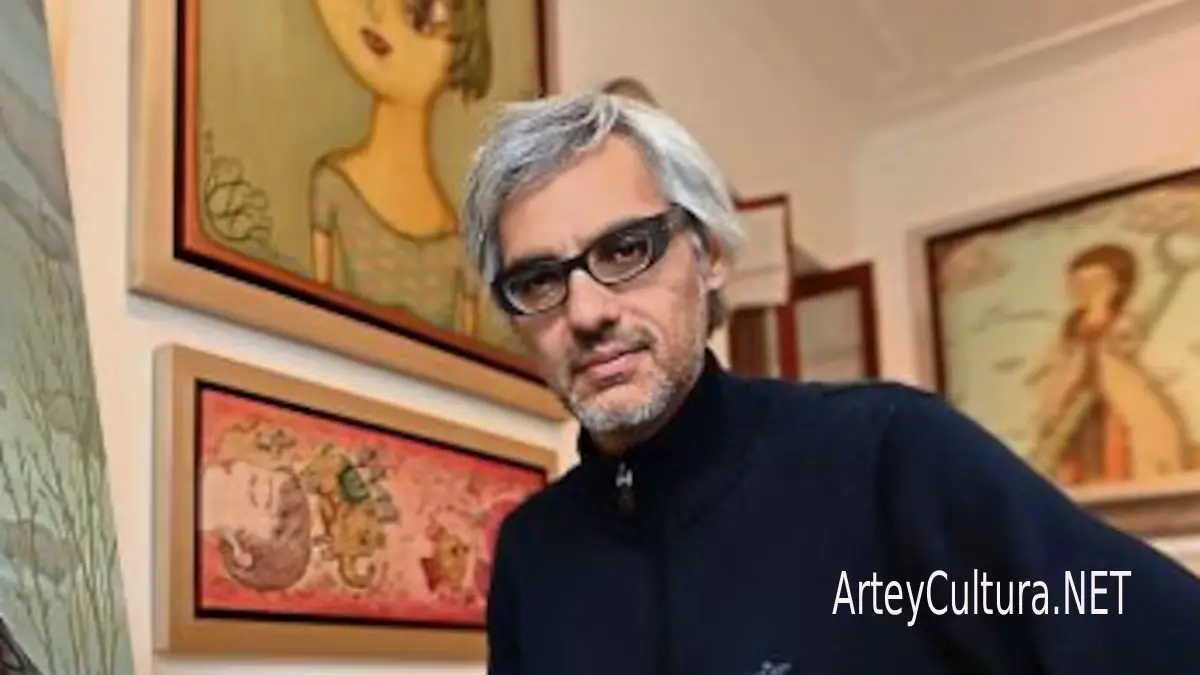
Fito Espinosa is a Peruvian painter, illustrator and writer whose images are recognised through simplified figures, open space and recurring symbols of vulnerability, affection and hope. His work reaches galleries, books and everyday objects without treating accessibility as artistic simplification.
Formation and early recognition
Espinosa developed through sustained drawing and painting, learning how a small change in posture or distance between figures can carry emotional meaning. Early exhibitions established a language based less on realistic description than on the precise organisation of signs.
An emotional alphabet
He repeatedly uses hearts, birds, houses, boats, ladders, moons and solitary bodies. These motifs function like an alphabet. Their meaning changes according to colour, scale and relationship: a house may shelter or confine, while a bird may suggest freedom, absence or an inner voice.
Because the symbols are familiar, viewers can enter quickly. The work remains open because no fixed dictionary exhausts them.
Painting and illustration
In painting, texture and colour create a physical atmosphere. Illustration demands greater compression and a close relationship with written language. Espinosa moves between them without confusing their purposes. A book image accompanies reading; a canvas must sustain its own time.
Colour and space
Muted fields may be interrupted by concentrated red, blue or yellow. Empty areas are active pauses rather than unfinished backgrounds. They allow a small figure to communicate isolation or possibility with unusual force.
Accessible art without simplification
Espinosa has brought images into publications and objects that circulate outside conventional galleries. Reproduction can widen contact with art, provided the work does not become a decorative formula. His strongest images retain ambiguity even when immediately attractive.
Video: life and creation
This Spanish interview explores biography, emotional experience and the origins of Espinosa’s symbols. No comparable English conversation was found, so the artist’s direct testimony is retained as a primary-source exception.
Video: dialogue and artistic craft
This Spanish cultural conversation offers a second view of process and professional practice. It is more relevant than substituting a generic English video about illustration.
Achievements and developing legacy
Espinosa has built an immediately recognisable visual vocabulary, connected painting with editorial illustration and brought emotionally serious art to broad audiences. His work gives form to experiences that are often difficult to state directly.
The legacy is still developing, but its core is clear: simplicity can be the result of careful selection, and tenderness can be a demanding artistic position.