Tilsa Tsuchiya: Myth and Modernity in Peruvian Painting
The life, symbols and legacy of Tilsa Tsuchiya, whose hybrid beings and silent landscapes created an essential mythology for modern Peruvian art.
- Tilsa Tsuchiya
- Peruvian painter
- modern Peruvian art
- mythology
- printmaking
- women artists
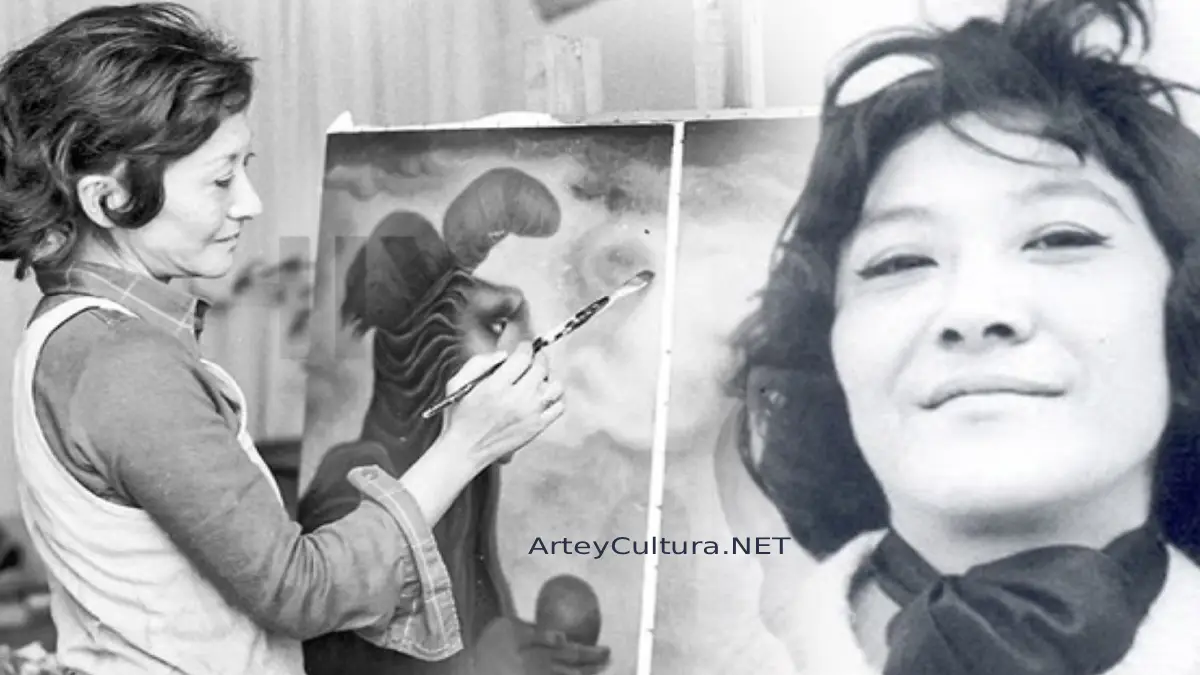
Tilsa Tsuchiya Castillo was born in Supe, Peru, on 24 September 1928 and died in Lima on 23 September 1984. Painter and printmaker, she created an unmistakable universe of hybrid beings, mountains, bodies and silence. Andean memory, Japanese ancestry and rigorous modern technique meet in images that appear ancient yet belong to no inherited mythology.
Childhood and cultural roots
Tsuchiya was the daughter of a Japanese physician and a Peruvian mother of Chinese descent. The coast, proximity to the Andes and several family traditions shaped her early imagination. The death of her parents interrupted her first period of study and forced her to assume family responsibilities.
Loss and persistence later entered her paintings indirectly. Figures wait, resist or cross uncertain territories. Biography becomes atmosphere rather than illustration.
The National School of Fine Arts
She studied at Peru’s National School of Fine Arts, where teachers included Carlos Quizpez Asín and Ricardo Grau. After interruptions, she graduated in 1959 with the Gold Medal in an outstanding class.
Academic discipline gave her command of figure, volume and constructed space. She did not remain within costumbrismo, nor did she abandon experience for pure abstraction. Her work sought a synthesis in which narrative, matter and colour could remain equally active.
Paris and the decision to return
In the early 1960s she travelled to Paris and studied printmaking. Museums and international art widened her resources, but the experience did not erase her roots. On returning to Peru she used engraving’s concentration of line and tone to deepen an iconography already taking shape.
Creating a mythology of her own
Tsuchiya’s elongated creatures, mountains and female bodies suggest myths without illustrating established stories. Human, animal and landscape forms merge. A figure may be guardian, victim, lover and territory at once.
This ambiguity distinguishes her from artists who simply quote pre-Columbian motifs. Cultural memory is active but never decorative. She invents images capable of addressing origin, desire, violence and transformation in the present.
Women, desire and power
Her female figures do not exist to please an outside gaze. They possess weight, agency and interiority. Couples and hybrid bodies turn sexuality into a field of tension rather than an anecdote. In this sense, Tsuchiya expanded the representation of women within Peruvian modernism.
Colour, matter and silence
Muted earth, blue and green tones create suspended climates. Carefully modelled volumes occupy open spaces where silence becomes part of the composition. Texture slows the act of looking; the paintings reveal themselves gradually instead of offering immediate explanations.
Recognition and maturity
Tsuchiya won the Tecnoquímica Painting Biennial in 1970, a decisive national recognition. Her mature work consolidated a personal symbolic language that resisted classification as merely surrealist, indigenist or international modernist.
Video: entering Tsuchiya’s universe
This Spanish-language documentary from Sucedió en el Perú reconstructs her biography and cultural setting. No English documentary of comparable depth was found, so the original is retained as the strongest contextual record.
Video: keys for looking at Tilsa
This Spanish visual analysis concentrates on symbols, composition and artistic development. It is a justified language exception: the close study of actual paintings offers more value than an unrelated English survey of Latin American art.
Achievements and legacy
Tsuchiya graduated with the Gold Medal, renewed Peruvian figurative art through an original mythology, integrated printmaking and Andean memory without subordinating either, and opened new ways to represent women, desire and identity.
Her enduring achievement is to show that modernity does not require cultural amnesia. The paintings remain open because they never settle into one definition: Peruvian yet universal, apparently ancient yet radically personal.