Bill Plympton: The Independent Art of Hand-Drawn Animation
The life, technique and legacy of Bill Plympton, whose pencil lines, comic metamorphoses and independent production model created a singular animated world.
- Bill Plympton
- independent animation
- hand-drawn animation
- Your Face
- Guard Dog
- illustration
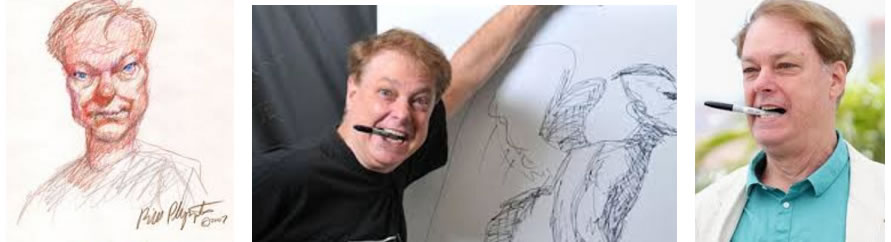
Bill Plympton was born in Portland, Oregon, on 30 April 1946. He is an American animator, director, illustrator and independent producer. Pencil texture, impossible transformations and absurd humour make his films immediately recognisable. Every trembling contour reminds the viewer that an individual hand created the image.
Plympton has made short films, features, commercials, music videos and television sequences while preserving a central principle: animation does not need to hide the act of drawing. In an industry built around large teams and polished uniformity, visible variation became his artistic signature.
Childhood in Oregon and the Disney ambition
Growing up in a family of six children, Plympton spent long rainy periods indoors drawing stories. He decided at five that he wanted to animate after encountering Disney films. At fourteen he sent drawings to Disney and offered to work there; the studio encouraged him but explained that he was too young.
At Portland State University he studied graphic design, drew for The Vanguard, edited the yearbook and designed film-society posters. An early animation experiment was accidentally photographed backwards. The failure taught him that imagination in animation must be matched by precise control of process.
Fifteen years as a New York illustrator
He moved to New York in 1968 and studied for a year at the School of Visual Arts. For roughly fifteen years he worked as an illustrator and cartoonist. His images appeared in The New York Times, The Village Voice, Rolling Stone, Vogue and Vanity Fair.
Editorial illustration trained him to communicate quickly, exaggerate a gesture and find an unexpected visual solution within limited space. Those skills later became the grammar of his films.
Entering animation on his own terms
Although animation was his childhood ambition, Plympton did not begin a professional film career until the early 1980s. Producer Valeria Wasilewski invited him to direct and animate Boomtown, based on a song by Jules Feiffer. The project introduced him to a complete production workflow.
He discovered that limited animation offered both economy and style. Rather than imitate the fluid movement of a major studio, he could choose decisive poses, repeat cycles and concentrate labour where a transformation or joke demanded it.
Your Face and the first Oscar nomination
In Your Face (1987), a seated man sings while his head stretches, collapses and changes material. The film lasts only a few minutes but presents an entire catalogue of metamorphosis. Maureen McElheron’s voice was slowed to create the strange male vocal heard on the soundtrack.
The short received an Academy Award nomination. It proved that a film made with modest resources could compete internationally when its idea, rhythm and visual identity were strong.
Video: Your Face
The artist’s official channel presents the complete Oscar-nominated short. Its English song and self-contained visual action make it fully accessible in this edition. Each mutation grows from the previous one, demonstrating that animation can show imagination itself rather than obey physical law.
Pencil, economy and metamorphosis
Plympton’s contours remain visibly irregular, and hatching gives bodies a vibrating surface. Storyboards and animatics establish rhythm before thousands of drawings create the movement. In several features he personally produced tens of thousands of images.
Economy is not concealed. Selective backgrounds, repeated movement and concentrated framing become aesthetic choices. Desire, jealousy, fear and aggression turn into literal bodily change: a kiss alters anatomy, a suspicious thought produces catastrophe, or a person becomes animal, machine or landscape.
Feature films and independent production
The Tune (1992) followed a songwriter through a surreal musical landscape. Plympton drew and coloured roughly thirty thousand images, demonstrating that a feature could be produced outside the conventional studio system. Later films include I Married a Strange Person!, Mutant Aliens, Hair High, Idiots and Angels, Cheatin’, Revengeance and Slide.
Independence does not mean isolation. He collaborates with producers, musicians, colourists and distributors but keeps a small structure and creative control. Festival screenings, commissions and sales of original drawings help finance subsequent work.
Guard Dog and the second Oscar nomination
Guard Dog (2004) follows a dog whose imagination turns ordinary creatures into threats. The repeated pattern—daily encounter, paranoid fantasy, return to the walk—allows escalating invention without losing clarity. The film earned Plympton a second Academy Award nomination and generated further adventures for the character.
Video: Guard Dog
This remastered edition from Plympton’s official English-language channel reveals how repetition, editing and surprise renew the same comic mechanism. The dog’s protective intention and disastrous imagination turn recognisable behaviour into a study of anxiety and perception.
Achievements and legacy
Plympton’s achievements include two Oscar nominations, a feature-length independent filmography sustained over decades, a graphic language grounded in pencil and metamorphosis, and a practical model combining festivals, commissions and direct art sales. He has also created memorable couch gags for The Simpsons and defended artists’ ownership of their characters.
His legacy is both artistic and economic. He showed that imperfection can become identity and that independence requires an understanding of production, rights, distribution and audience. In a medium capable of erasing every trace of labour, Plympton made the trace of the hand the principal character.