Eduardo Naranjo: Memory and Poetry in Spanish Realism
The training, paintings, drawings, prints and legacy of Eduardo Naranjo, whose technically rigorous realism transforms memory and dream into poetic images.
- Eduardo Naranjo
- Spanish realism
- figurative painting
- Spanish printmaking
- Poet in New York
- contemporary art
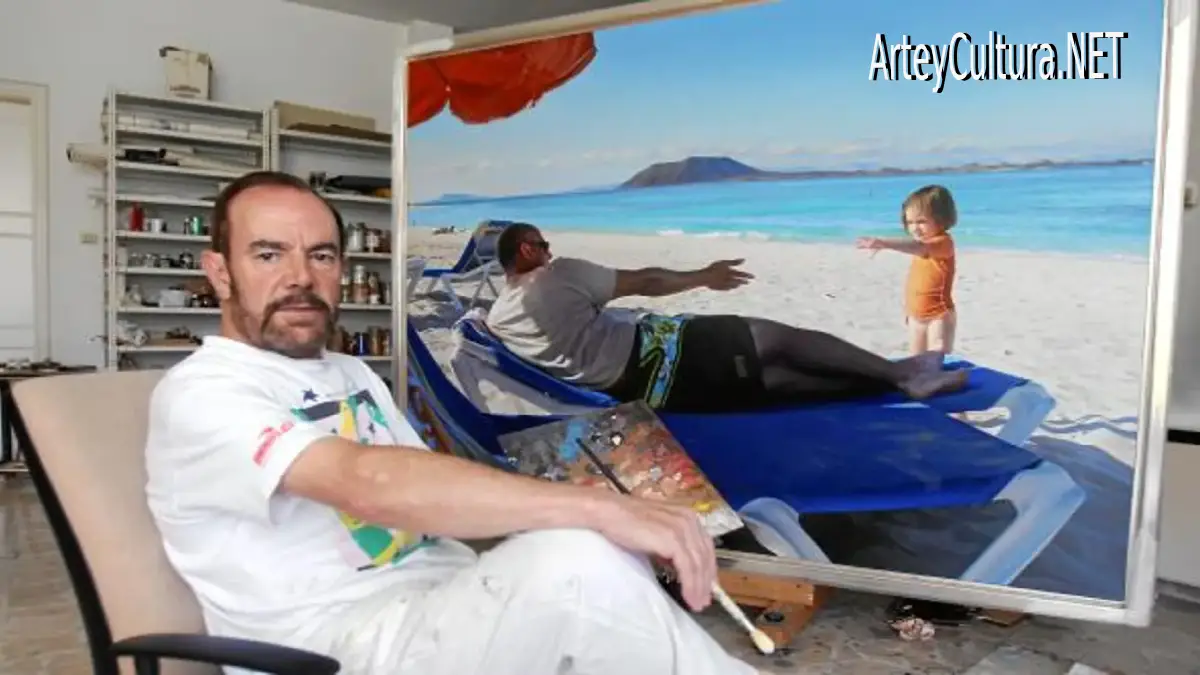
Eduardo Naranjo was born in Monesterio, Badajoz, on August 25, 1944. A Spanish painter, draughtsman and printmaker, he uses exacting technique not to copy visible reality but to construct spaces where memory, dream and physical observation overlap.
Education and artistic foundations
Naranjo trained in Seville and Madrid and continued his studies in Paris. Academic drawing gave him a disciplined command of anatomy, perspective and materials, while encounters with modern art encouraged him to treat figuration as an open language.
His mature work emerged during a period when realism was often positioned against abstraction. Naranjo avoided that simple opposition: recognisable forms become carriers of ambiguity rather than guarantees of certainty.
Precision transformed by imagination
Curtains, bodies, landscapes, glass and ordinary objects appear under carefully constructed light. Reflections interrupt surfaces, forms overlap and apparently solid spaces acquire the instability of recollection.
The technical finish attracts attention, but the image is not photographic duplication. A shadow may introduce a second narrative, while an object can function simultaneously as observed matter and private symbol.
A visual introduction to the work
This Spanish-language survey allows close attention to Naranjo’s drawing and atmospheric control. It also demonstrates the variety of scale and media that a small online reproduction can obscure.
Painting, drawing, print and mural
Naranjo has worked in oil, drawing, engraving and monumental decoration. Moving between these media required different relationships to line, surface and time, but the tension between tangible form and inner vision remained constant.
His graphic cycle inspired by Federico García Lorca’s Poet in New York is particularly important. Rather than literally illustrating every poem, the prints respond to Lorca’s urban dislocation and symbolic intensity.
The artist explains his practice
In this Spanish interview, Naranjo discusses his formation and artistic concerns. Hearing the artist is valuable, though interpretation should continue through the works rather than treating biography as a code that explains every image.
Achievements and legacy
- He sustained figurative inquiry as a vital contemporary practice in Spain.
- He united technical discipline with autobiographical and dreamlike space.
- His printmaking created a substantial dialogue with Spanish poetry.
- His work demonstrates that realism can question appearances rather than simply confirm them.
Naranjo’s legacy lies in this productive contradiction. The more precisely his world is rendered, the less certain its boundaries become.