José María Arguedas: A Literary Testimony of Peru
The life, writing and cultural work of José María Arguedas, read through his 1966 Literary Testimony and his lifelong dialogue between Quechua and Spanish.
- José María Arguedas
- Peruvian literature
- Quechua
- anthropology
- Deep Rivers
- All the Bloods
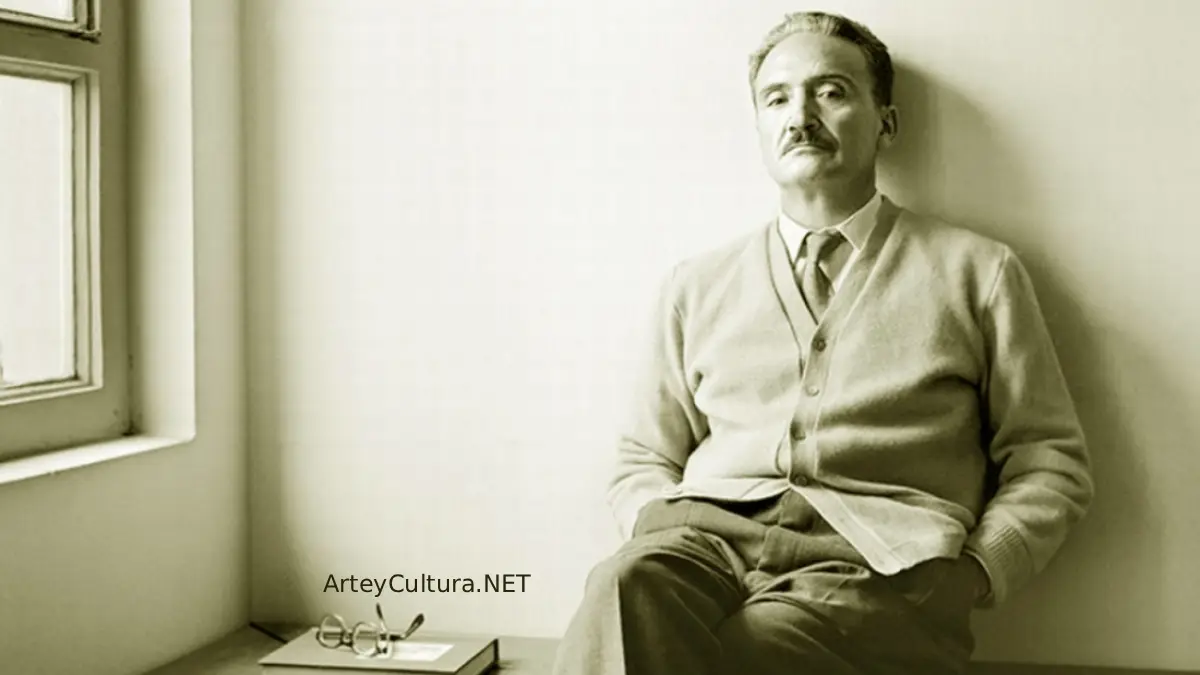
José María Arguedas Altamirano was born in Andahuaylas, Apurímac, on 18 January 1911 and died in Lima on 2 December 1969. He was a novelist, poet, anthropologist, ethnologist, translator, teacher and cultural administrator. His work transformed Peruvian literature because he did not treat the Andes as a distant landscape: he wrote from deep knowledge of its languages, affections, conflicts and relationship with nature.
On 24 September 1966, before students at the Federico Villarreal National University, Arguedas delivered a lecture known as Testimonio literario or Motivaciones del escritor. He connected childhood, vocation and books while reflecting on hope and disenchantment across generations of Peruvian writers. The recording lets us hear an author interpreting his own path, although his testimony must also be understood within its historical moment.
Childhood, loss and the Quechua community
Arguedas’s mother, Victoria Altamirano Navarro, died when he was two and a half. His father, Víctor Manuel Arguedas Arellano, was a lawyer and itinerant judge. After his father’s second marriage, José María lived in Lucanas under a stepmother and stepbrother who mistreated him. He found affection among the Indigenous workers of the household and learned Quechua as a child.
This experience was not simply a division between two sealed worlds. Arguedas encountered a Peru marked by inequality but also by constant exchange. Quechua was more than a vocabulary: it carried music, memory, communal relationships and a way of feeling the landscape. Spanish later became his literary instrument, but Quechua remained an inner structure of rhythm and perception.
Education, prison and teaching
His father’s journeys took him through several Andean towns. He studied at the National University of San Marcos, specialising in literature and later ethnology. In 1937 he was imprisoned for participating in a protest against an Italian fascist delegation. The experience informed El Sexto, his 1961 novel about political conflict and human dignity inside a Lima prison.
Arguedas taught in schools and universities while conducting ethnographic research. He never considered literature and anthropology to be opposing activities. Fieldwork, translation, education and fiction were different ways of confronting the same question: how could a culturally diverse nation recognise itself without forcing one of its peoples to disappear?
Writing Quechua experience in Spanish
His central artistic challenge was to make Spanish carry the emotional and rhythmic force of Quechua without reducing Indigenous speakers to stereotypes. He altered syntax, cadence and imagery so that the language of the dominant society could transmit a different sensibility.
His first story collection, Agua (1935), depicts local power and communal resistance. Yawar Fiesta (1941) explores conflict around an Andean bullfight and questions the assumption that modernisation must erase local practices. Deep Rivers (1958) joins personal formation, nature, memory and social violence through the adolescent Ernesto.
In All the Bloods (1964), Arguedas attempted a broad portrait of Peru under pressure from capitalism, land conflict and incompatible visions of development. Critics challenged the novel’s social model, but its ambition remains fundamental: it asks whether national unity can exist without suppressing cultural difference.
The 1966 Literary Testimony
In the Villarreal lecture, Arguedas spoke about the experiences that compelled him to write. He recalled Indigenous communities not as passive victims but as creators of beauty, solidarity and resistance. He also situated himself in relation to earlier Peruvian writers, recognising their achievements while explaining why his own generation required another language and perspective.
The testimony is valuable precisely because it is personal. It is not a neutral map of Peruvian literature. It shows how an author constructs continuity between childhood, social responsibility and artistic form.
Anthropologist, translator and cultural servant
Arguedas collected songs, myths, dances and oral narratives. His translations made Quechua poetry accessible to Spanish readers while insisting that it was literature, not anonymous folklore. Works such as The Singing Mountaineers and his studies of Andean communities joined careful documentation with respect for living cultural practice.
He served as director of the Casa de la Cultura and the National Museum of History, and worked in the Ministry of Education. These roles reveal another dimension of his legacy: culture needed institutions, archives, museums and educational policies, not admiration alone.
Video: reading Deep Rivers in English
This English-language lecture examines conflict and convergence in Deep Rivers. It is useful for readers approaching Arguedas through translation because it explains why the novel refuses a simple choice between cultures and instead represents encounters that remain creative, painful and unfinished.
Video: Arguedas’s own voice in 1966
The original Spanish recording of Motivaciones del escritor is retained as an exceptional primary source. No second substantial English-language video covering this testimony was available. Even for non-Spanish speakers, the cadence and intensity of Arguedas’s delivery convey the oral dimension that shaped his prose; the English commentary above supplies the necessary context.
Final years, death and legacy
Arguedas experienced severe depression for much of his adult life. On 28 November 1969 he shot himself in his office at the National Agrarian University La Molina and died on 2 December, aged 58. This ending should be treated with care and must not become the sole explanation of his work.
His achievements include renewing Spanish prose through Quechua rhythms, producing major novels and ethnographic studies, preserving songs and oral traditions, and defending cultural plurality through public service. Arguedas remains essential because he understood identity not as a pure inheritance but as a difficult, changing relationship. His writing asks how different peoples might inhabit one country without demanding silence from one another.